You'll actually look forward to your morning commute. Life is calling. How far will you go? Learn more about the Peace Corps

Monday, October 25, 2010

Correspondances

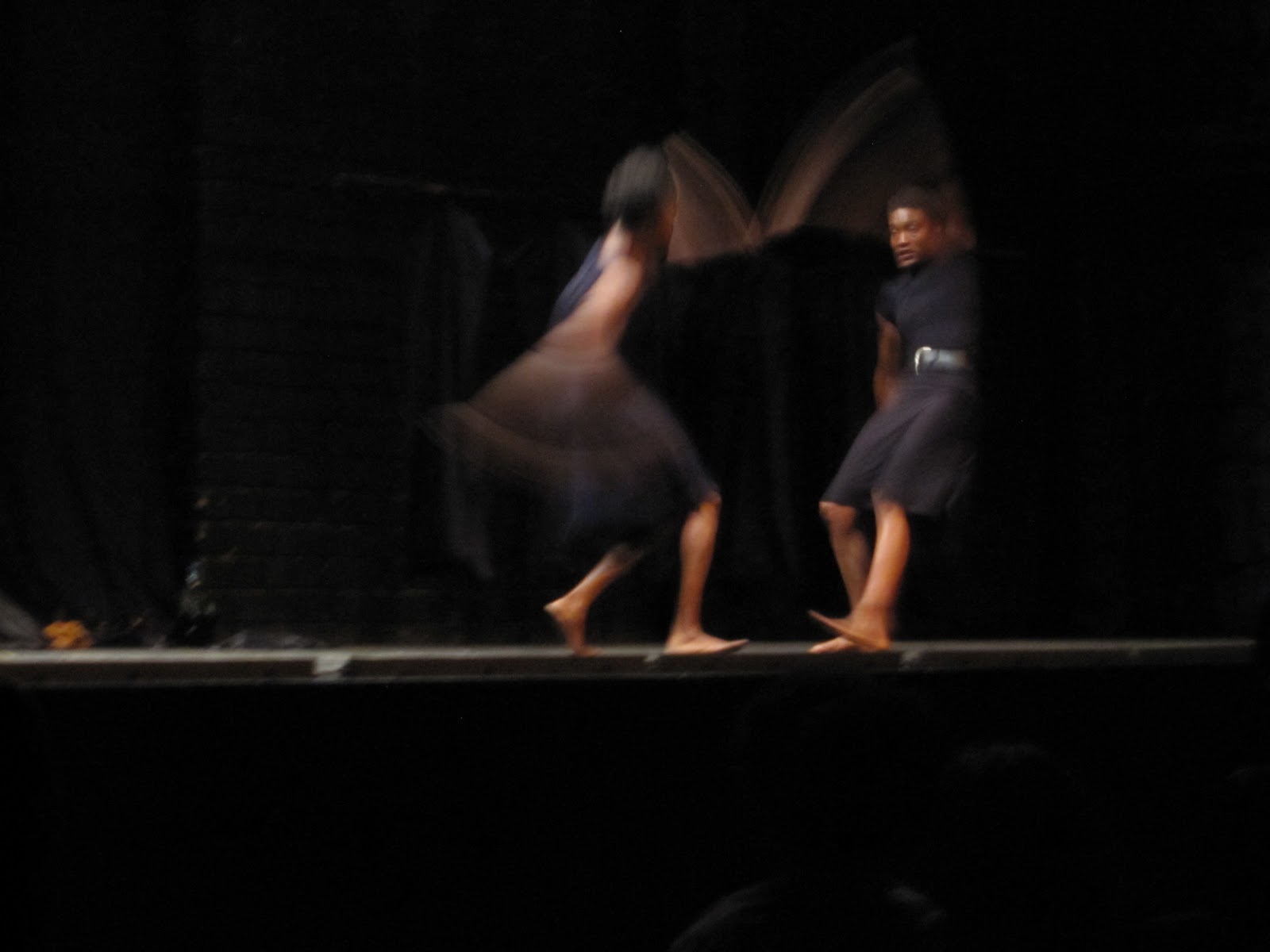
 Kettly Noel (l) and Nelisiwe Xaba (r)
On Friday night some friends and I, after eating pumpkin soup on my roof under a nearly full moon, attended Kettly Noel (Mali, Haiti) and Nelisiwe Xaba (South Africa)'s choreographed contemporary dance piece "Correspondances" at the French Cultural Center.  All I knew about the performance before I entered the theater was that it was about women meeting each other in different places.  The blurb on the Center's website did not prepare me for what I saw. 

Nelisiwe enters through a curtain covered doorway in the middle of the stage.  She wears a black and white flower-patterned trench coat and staggering stiletto heels.  Behind her and to the left is a row of hanging, black suit bags and matching black sacks on the floor.  She begins to describe her morning routine, in English and with her body, the places in her home where she checks out her outfit, make-up and hair each morning before heading out into the fray.  She says if she's going to have men craning their necks to look at her - she wants to give them something good to look at. 

Setting the scene
Then, Kettly announces her presence on the scene, breaking Nelisiwe's mirrors-in-the-morning monologue, from a balcony upstairs.  She's wearing a short skirt and carries a briefcase like you'd imagine a flapper in the 1920s holding at a train station.  She floats downstairs and starts giving bisoux to folks in the crowd, waving as though they're old friends and then climbs onstage, sets down her suitcase and steps to the back of the stage for a costume change. 

While Nelisiwe performs a dance with a 2 ft high doll pulled from Kettly's suitcase, Kettly non-chalantly changes into a black dress and a new pair of heels in the background, a simple black leotard on underneath which, while just like a bathing suit, is extremely shocking in conservative Mali.  I'm not used to seeing anyone else's legs but my own!  The two proceed to simulate a club atmosphere and their bodies speak not only to one another on the stage, asking and answering in a rapid-fire succession, but also to the audience as we imagine ourselves or others in a dance-club.  The two begin to hip-bump - playfully at first and then violently - as they compete for the attention of an absent man. 

Can you do this?
While Nelisiwe changes, Kettly pulls a microphone into the middle of the stage and begins a feminist monologue.  She lists her womanly attributes in emphatic French. Sensulle.  Oui.  Sexuelle.  Oui.   Sensitive.  Oui.  Soumise*.  Non.  Interessante.  Oui.  Belle. Oui.  Je suis une femme globale, oualie!  Then, she speaks about the state of Africa in the world and Anglophonie and Francophonie and asks us when will we start talking about Afriphonie? (one of my favorite parts of the show).  She ends the monologue by dragging the mike-stand off stage, verbally asserting her sensuality, as she burps loudly into the microphone.

The dance ended with an interesting statement on, well...it's hard to say.  It was a little graphic, mildly messy and a whole lotta confusing.  All I can say is check out the artists on YouTube if you're interested in learning and seeing more.  Throughout the performance Kettly and Nelisiwe coupled vehement social statements with satire, using their bodies and words, concerning Africa, women, friendships, love and politics for a dance performance that left me in awe of the capabilities of the human body and shaking my head at the meaning of it all.  Three days later I'm still talking about the performance with the folks I went to the show with and am looking forward to the Danse L'Afrique Danse! biennial in Bamako next week. 

Post-show - two medical gloves and a stage of fake milk...

*Submissive


Sunday, October 17, 2010

The new National Park of Mali

 a hibiscus tea break at the garden
Around 12:30 a lunch bell rings in my head and I fish 300 CFA out of my wallet, tie my sun hat on my increasingly blond head, slip my lanyard-string museum pass around my neck and look both ways before crossing the street from the PHARE complex to the parking lot of the National Museum of Mali.  Fatoumata's table, surrounded by broken-down museum buses in a forgotten corner of the lot, is laden with rice and sauce and occasionally frozen sweet drinks that she sells to museum employees, security guards and toubabs like me on a limited lunch budget.  I set my money on the table and collect a plate of tigadegana with hot pepper sauce and a bottle of hibiscus juice and enter the park grounds through the back door.

On October 1st the National Museum of Mali hosted the opening of the National Park of Mali situated on the museum grounds and spanning over 250 acres.  The National Park, financed and designed by his Highness Aga Khan and his eponymous foundation, offers two restaurants (in addition to the museum's), a tea house, playgrounds, a fully-equipped fitness center and juice bar, a traditional medicine garden, fountains and numerous benches to support tushes tired from walking around the expansive environs. 

yellow-brick road
For 5,000 CFA/month I have unlimited access to the gardens where I eat lunch each work day and, if I'm feeling spunky, run in the afternoon.  The paths on the perimeter are lined in loose gravel and the center walkway is paved in cobblestone and culminates in a multi-level restaurant with a terraced duck-pond below.  Strolling couples and track-suited joggers crunch up and down the gravel paths, teenagers with cell phones and ear pieces try out the fitness equipment and friends sip afternoon sodas and coffee and munch on croissants at the tea house while soaking up the garden air and sacred sound of silence in air-and-noise-polluted Bamako. 

 Fletcher in the flowers (he's another PCV at PHARE)
On Saturday night the museum hosted the opening of an exposition titled 'North meets West' in their temporary exhibit space.  Massaran and I, a neighbor and friend, ventured to the museum on Saturday afternoon with her baby Aboudou on her back and my camera in hand.  The exhibit is the culmination of a 10-day workshop held in Bamako for a group Norwegian and West African artists from Burkina Faso, Ghana, Togo and Mali.   

Mama Bamako, 2010 - Bjoern Noergaard
Lunch, art exhibits, scenic benches - whatever the reason, the National Park and Museum of Mali provide the answer.  It's the right price, $10 a month for unlimited entry and 250 CFA/visit for residents (about 50 cents) and the right location for me (across the street from work and a 10 minute drive from home).  The garden gods have smiled on Bamako and I feel blessed for it!
tea house by night-light
see more pictures from the park and Bamako here

Monday, October 11, 2010

An ECU delivery and Vieux Farka Touré

On Thursday at 4 pm, Land Rover packed and ready to go with teaching materials for the San region 'Ecoles à Classe Unique', I climbed into the front passenger seat, buckled in and Oumar and I set out for San.  With Africando music on repeat on the tape player and popcorn and a candy bar between us, Oumar recounted all the trips he's taken as a driver for NGOs as we snacked our way to San.  Oumar's memory amazed me as he listed not only the year and location of his trips to places like Kidal, Niger and Chad but also the full names of all passengers on each mission.  Popcorn long gone and fingers sticky from the chocolate, we pulled into the first ECU village by 10:30 pm where we unloaded the materials and a metal case and were on our way to San by 11. 

Two of the trunks with materials inside (l) and the materials all unloaded (r)          
The next morning, waiting on a second load of teaching materials from Bamako (for three other villages), I made a trip out to my village to visit Annie, Esayi and the new volunteer, Jim.  Rainy season continues to the bafflement of most and to the dismay of anyone trying to navigate mud paths to villages 'en brusse' - getting out there took over twice the amount of time it should have.  I wasn't expecting to get back to village before going home in December and I was surprised by my nervous feelings as I left San.  Five weeks after leaving though, unsurprisingly, not much has changed and my nervous feelings melted as soon as I saw Annie, Esayi and baby Christine.  It felt great to see Jim in his new home and answer questions he had and also to see how well he fits in with the Coulibaly groove.  I was never nervous about him fitting in but seeing how much folks like him with my own eyes and how well he is adjusting was comforting all the same.  Annie has also put on 3 kilos (about 6 pounds) since our visit to the health clinic in August and Christine's little baby body has fattened up all over - not just in her belly. 

Oumar and I returned to San at 8 pm after delivering the rest of the materials that afternoon and made our ways to our respective jatigis (hosts) in San.  I got to greet the butigi owner Bacho and his brother Moulie and the official San-kaw tailor Abu.  I told Abu how everyone in Bamako loves my outfits and raves about how good my tailor is to which Abu replied he was looking for a studio in Bamako. The competition is fierce so I said I'd keep an eye out for vacant shops. 
Vieux Farka Touré and the band (photo - Pamela)
Oumar dropped me off at my house just after 4 pm on Saturday where I showered and got ready for a Vieux Farka Touré concert at the French Cultural Center.  Beforehand, I attended a birthday celebration dinner at my boss's home complete with gouda cheese, pudding, champagne and presents for the guests.  Everyone was going to the show so after the party we loaded into cars to get to the center where for 3,000 CFA (about $6) I saw one of the most famous Malian musicians perform to a sold-out crowd of about 350 people.  The concert included a lot of flashing, colored lights, use of a fog machine and encouragement to get up and boogey.  The whole band wore varying degrees of intricate bazin boubous - Le Vieux's the most embroidered and shiny of them all.  The bassist wore grey converses and the woman I was staring at all night in the front row with an exquisite pink and red bazin complet with puffy sleeves turned out to be Le Vieux's wife.  The older, reserved, ex-pat crowd isn't what Le Vieux is used to as he consistently referred to our relaxed atmosphere and calm demeanor but it was an awesome concert nonetheless.  In the end there was lots of dancing and with such an intimate setting, time for one-on-one greeting and photos afterwards.
 
me and Vieux Farka Touré (photo Pamela)
The next morning I went downstairs to greet my host family including Madame Diallo and her steady stream of visitors and tell them about my visit to San and the Vieux Farka Touré concert.  Madame Diallo asked who Vieux was and I said a Malian singer.  'Why did you go to visit him,' she asked.  'Did he die?'  I guess he needs to work on his national fan base!

Wednesday, October 6, 2010

Les Ecoles à Classe Unique (ECU)

Teachers discussing ECU information packet
The last two weeks of September I shadowed a handful of PHARE staff at a primary school on the banks of the Niger river in Ségou for an intensive training of teachers and academy directors on the 'Ecole à Classe Unique' (ECU) program the Ministry of Education is implementing with 35 schools this year after piloting the program last year with 5.  After spending over 80 hours spanning 2 weeks with 35 teachers, 7 pedagogical advisors, 20 teacher trainers and part of the PHARE staff, I re-emerged in Bamako rubbing visions of the alphabet out of my eyes and with the ringing of children singing instructional songs in my ears.  
Kids reading at an outdoor practicum
Camera in hand and Power-point warming on the computer, I spent morning, pause café and afternoon roaming from classroom to classroom and session to session to document the ECU training for tax-paying folks back home (and their dependents) and my bosses and colleagues in Bamako (the Americans of which I hope also pay their taxes).  Along the way, I learned what an ECU is and how it is supposed to be implemented in Mali.   
 Interactive learning on a mat
ECUs are intended for villages where the primary school population does not exceed 40 and the closest primary school is 10 km or more away - too far for a child to walk.  The idea is that instead of kids having to walk to school - or simply not go which is more often the case - the school will go to them.  By reaching out to isolated populations through ECUs, PHARE is assisting the Ministry of Education to realize the goals set forth by the United Nations and the Millennium Challenge mandating universal primary education by 2015.   

PHARE sought to achieve certain objectives with this training, one of which was how to organize the ECU classroom.  Some teachers will hold class in a one-room school house and others will conduct school under the shade of a mango tree and on the surface of a plastic mat.  Other objectives included how to employ active teaching methods in the classroom, how to use the interactive radio sessions broadcast on ORTM (the Malian National radio station) and produced by PHARE, how to produce teaching material in the respective national languages and to discuss the history of the ECU in Mali.  PHARE staff also spent time working with the directors of the teaching academies to discuss the evaluation of ECU teachers and how it differs from those with a single-level classroom. 
Moussa teaching icebreakers (hangman) 
With grades 1-6 in one classroom the teacher encounters new challenges to engage all students simultaneously and to effectively instruct.  One of the guiding principles behind ECUs is the desire to instill autonomy in its students by encouraging them to teach one another.  For example, during language arts, the 4, 5 and 6th grade students can pair up with the 1st, 2nd and 3rd grades to produce books.  The older students write the story while the younger ones illustrate.  With math, while the teacher helps the 5th and 6th grade students with long division, the 4th graders can help the 1-3 levels with their addition and multiplication - correcting and guiding each other along the way.  

With over 14 languages, 7 of which were present at this training (Bambara, Dogon, Peul, Songhai, Tomashek, Bomu, Bozo), the Malian Ministry of Education (and PHARE!) has its work cut out for them to produce quality bi-lingual classroom materials and teachers capable of implementing it.  The amalgamation of languages made for colorful conversations at the training and also a lot of nagging about why I only speak Bambara and French.  Why don't you learn Fulfuldae? the Peuls would say.  What about Bomu? said the Bobos.  And don't forget about the Songhai of Kidal! said the cute, little old man who had never before this training been past Gao.  I would smile, offer up the word or so I know in their language (if any), and joke about all the beans they ate before coming to the training.  After all, not only were they (jokingly) insulting my capacity to learn obscure African languages, they said the man drawn on the chalkboard after the lost game of hangman was a Coulibaly!
 
Transcribing the training information (delivered in French) into national languages (Tomashek seen here)

 One of the participants in the middle of a simulation lesson to practice what was learned
Bringing all the levels together for a lesson

Friday, October 1, 2010

Some after photos of the new place

I'm back after a two-week training in Segou with a few things left to do: painting of tables and book shelves, buying a fridge, etc.  More to come soon on the training! 

the kitchen
Living Room
 Bedroom


Sunday, September 19, 2010

Worth the wait!

Walking through sugu-kura in the Hippodrome quartier, Sekou, who works for PHARE doing administrative tasks, calls to say he has an apartment for me to check out - can I meet him at my boss's place right now? I hang up the phone and put down the pile of tomatoes I am haggling over, ask God's blessings for the woman's business, and make a beeline to the road to catch a Sotrama.  As wonderful as it is staying with one of my bosses, after a week in Bamako I am ready to move into my own place.    

30 minutes later, Sekou knocks on a large, metal gate and we enter a stone courtyard.  A mango tree grows in the middle of the enclosure and I eye a cute baby on the tile patio toddling after one of the house cats.  Fruit trees and a cute baby - so far, so good.  Sekou and I slip off our shoes and enter the living room where a sizable women sits on a cushy chair, prayer beads slowly rotating through her fingers, and bazin-clad visitors eye me suspiciously from their seats on opposite couches.  I offer my hand to the woman in the chair and dip as I shake hers to show my respect.  She gestures for me to sit on the couch beside her as Sekou explains we are here to see if the apartment upstairs is a good fit for me.  The woman, introduced as Madame Diallo, nods her approval and gestures for me to go to the door.  As I leave I feel the eyes of Madame Diallo's guests on me and, sure enough, I turn to find 5 pairs looking in my direction.  I start to feel less like I am here to approve of the apartment and more like I am here to be approved of by Madame Diallo and her family.  I straighten my pagne and slip back on my shoes to head upstairs. 

Sekou leads me up a broken-tile mosaic stairway that curves around and up to an East facing apartment.  It's as though the family decided their home needed a little something else and plopped a three-room dwelling on their roof.  Metal rods stick out at regular intervals, a way (I assume) of evading real-estate property taxes since owners of 'unfinished' residences (i.e. those with exposed metal rods) are not required to pay taxes on their real-estate.  Sekou gently guides me around the exposed tetanus hazards while I marvel at the panoramic view.  To the North-West there's a large, packed dirt clearing.   Around the perimeter women sell fried dough and paté and in the center young guys chase after lobbed soccer balls.  Those who are less athletic watch from the sidelines in plastic-string chairs while playing cards and pouring tea from charcoal-heated, silver pots.  In the distance a hill slopes down and to the East, framing the scene and leading my eyes back to the apartment.

I hesitate before we enter because there are no visible windows.   A lover of natural light, I remind myself to keep an open mind - good apartments in this neighborhood are hard to come by and I can only be but so picky.  But as Sekou opens the door I see I have nothing to worry about.  Afternoon light pours in through windows on the West wall through gold curtains and spills over onto the fully furnished living room.  It's more than I could have hoped for!  In the next room, I find a bedroom outfitted with a bed-set, a real mattress (I've been sleeping on a foam mattress squished down to about 2 inches) and an armoire with full-length mirrors.  At the end of the bedroom is a bathroom with a toilet, sink and shower.  While bathing under the stars was one of my favorite parts of living 'en brusse', it will be nice not to have to truck outside in the middle of the night to heed mother nature's calls.  An empty room to the far left could serve as the kitchen.

I gush to Sekou that I love it and he heaves an audible sigh of relief and flashes me a big grin.  He's been dashing around the city for the past couple weeks following leads here and there of vacant apartments that fit PHARE's parameters and I can tell he's glad the search is off.  We close the window shutters, lock the front door and head back downstairs to tell Madame Diallo the news. She's finished praying now and her guests have gone.  She tells me she's 'très contente' I'll be living upstairs and as we say our goodbyes I try to contain my giddiness - I finally have a place to live.  Leaving the compound and making my way back to my boss's to let her know the good news I'm reminded - some things really are worth the wait!
 The bedroom before
More pictures (afters!) to come soon - the internet is being slow!

Tuesday, September 14, 2010

Quest for a mosquito net and sheets

Leaving work on Friday, I collect my bag and leave my air conditioned work area to enter the fray of market where steamy heat clings to my skin.  I walk down a tree-lined avenue, taxis honking at me to ride instead of walk, towards sugu-ba (the big market) to purchase new sheets to fit my new mattress and a mosquito net.  I stop for a snack at a portable vietnamese stand and watch as people narrowly avoid motorcycles and close-cutting taxis weaving in and out of traffic as they navigate their own way to market.  I finish my spring-roll treat and, after following the directions of fellow shoppers and shopkeepers down this street and winding back that one, I finally find what I'm looking for.

   My work space with Almamy Traoré (left and smiling) and Sah Cissé (right and at work!)
The smell of fried dough and open sewers rise up to mix for an unwelcome aroma as I enter the shop.  A discreet storefront, one of the few open ones the day after (or of, depending on when you saw the moon) Ramadan where yards of pastel fabric hang from the ceiling and pool together in a single, large, wrinkled mass on the floor.  I plunk myself and work bag onto a roughly made plank bench and look around the shop which is no larger than a small, walk-in closet.  I quickly see what I came here to buy: a flowing, lace-adorned pink mosquito net and light pink sheets with embroidered flowers.  I ask for the net and 3 meters of the fabric to get sewn into a fitted sheet at a tailor near my home. 

Outside the PHARE office


A man lounges on a chair outside the door and, nodding towards my bag of embroidered sheets and mosquito net scoffs, 'Pink?  It's because you're a feminist.'  I look back at him, puzzled, recalling the feminists I know.  The shopkeeper comes back with my change and, smiling at the funny observation of the lounging man, I start the walk home as the once threatening clouds begin to pour buckets from the sky.  I cringe as I miscalculate puddles and pull my shoulders in under my red umbrella while passing shopkeepers quickly covering their wares with forlorn, plastic sheets.  The only colors visible in a once vibrant market are the shiny troops of families returning from greeting for Ramadan in bazin complets (a fancy type of fabric) and new, holiday sandals as they walk quickly to find shelter from the sleeting rain. 

 A nems stand.  Yuumm.
I forgo the teetering Sotramas, filled with passengers dressed for Ramadan celebrations, and decide to walk, even though it's a long way home, because the rain lets up and the afternoon is mine.  I turn off to walk behind the main road where kitchen gardens line the mud paths and guards in maroon uniforms and matching caps sit in plastic lawn chairs outside villa walls.  The air is decidedly cleaner only one street off the main road - fresh vegetable smells replacing the stifling odor of unfiltered exhaust.  For a minute I'm transported out of Bamako and back to village where bending millet stalks and flowering okra line the paths to village rather than crumbling sidewalks and gaudy home furnishings. 

I follow the rising spires of the large mosque near my home to find my way in the maze of intersecting, muddy roads.  My neighborhood is characterized by large, shady trees and as I near my home I fold up my umbrella and let the rainy season breezes and afternoon sun wrap around me.  Mining offices and small hotels are interspersed with tiny hardware shops, tailors and egg-sandwich stands in the area.  I dodge errant soccer balls kicked by little boys in Spanish soccer jerseys and greet groups of women braiding hair outside metal lean-to beauty boutiques.  I climb the tile-mosaic stairs to my apartment, gauzy net and cotton-candy pink fabric spilling out of my overflowing bags, and collapse on my couch.  I turn on the ceiling fan and close my eyes as the afternoon call to prayer pours through my windows. 

Tuesday, September 7, 2010

My work in Bamako - In honor of International Literacy Day (September 8)

A week ago I moved from a village with a population of 1,000 to Bamako - a city with a population of over 1,000,000.  I moved from a mud hut where branches reinforced my roof and I used an outdoor latrine to a cement house with indoor plumbing, ceiling fans and electricity.  Instead of working with farmers and a women's group, I work with the Programme Harmonisé d'Appui au Renforcement de l'Education (PHARE), the Ministry of Education and USAID employees.  Instead of biking 15 miles to get fresh food, I hop on a Sotrama (the public mini-bus system where you pay 125 CFA/ride - about 12 cents) to pick up fresh vegetable and household supplies from open markets and shops on the way home from work.  

PHARE is a $30 million program funded through USAID that coordinates with the Ministry of Education to improve the quality of teacher training in Mali through direct teacher training, radio broadcasts, smart phones and virtual training centers.  I will not be teaching students but rather assisting in the development of lesson plans, teacher training manuals and communication/public relation materials. 

This past week I took part in a number of meetings.  One of them was with the 17 directors of the teaching academies of Mali where I listened to one of my bosses, Rebecca Rhodes (an RPCV from Guinea),  report on the work PHARE completed during the 2009-10 school year and what the program hopes to accomplish (in coordination with the directors) in 2010-11.  Later in the week I sat in on training-schedule development meetings and made a visit to a village 70 km from Bamako where PHARE is monitoring the success of the one-room schools the ministry is promoting throughout Mali (it was a long and bumpy ride that my stomach couldn't handle!) One-room schools are implemented in villages where the child population is under 40 and one teacher teaches grades 1-6.  It has been applied to schools around the world with great success. 

In Mali, public school begins in early October.  The interactive radio programs PHARE has produced, the primary tool for reinforcing French literacy skills, are 30 minute lesson plans and will begin to broadcast in mid-November.  The interactive radio programs provide teachers with learning tools on how to teach (over 1/2 of teachers receive NO formal training) while simultaneously helping students to learn French which they need if they want to be competitive in either the national or international job market later on and also for their own educational development.

See and hear what interactive radio programs are like in Somalia 

Statistics show that by the end of grade 4 in Mali, only 23% of boys and 10% of girls can read a simple sentence in French.  Mali ranks at the bottom of the United Nation's literacy rankings.  Can you imagine sending your child to school and them not learning the alphabet until the third grade?  That's what happens in Mali.  Can you imagine sending your child to school to share a classroom with 100 other students and one teacher?  That's what happens in Mali.   Can you imagine sacrificing an extra pair of able hands on your farm and paying for your child's education only to have them come home having learned nothing?  That's what happens in Mali.  After witnessing the fervor with which Annie and Esayi pursued their own children's education in village, having received limited education themselves, I feel the pressing need for an improved education system in Mali.  Quality education produces people who are able to inform themselves on civil issues and creates an informed voter base who can then elect quality, non-corrupt leaders which in turn leads to an improved economy and internal infrastructure which then overflows into all aspects of social and economic development. 

I feel blessed to have spent 2 years living in a rural village where Annie, Esayi and my neighbors taught me about life in Mali (and also for the public education I received in Virginia!).  I am looking forward to applying the cultural lessons learned in village to an office setting in Bamako and towards work I truly believe in.  I have engaging and interesting bosses and colleagues, stimulating work and a beautiful National Museum to visit during my lunch breaks.  While my job description has changed and I will play in a lot less dirt than I did in village (with 999,000 more people around), my reasons for being here are the same.  I live in a beautiful country with warm, welcoming people and I have work that challenges and inspires me.  Allah k'a i deme!

Saturday, September 4, 2010

Annie's pre-natal consultation in Mali*

When I returned from America in July I saw Annie for the first time in over 1 1/2 months (due to COS conference and my sejour home) and I immediately noticed that her belly - though not the rest of her - had grown significantly.  While it is culturally inappropriate in Mali to reference a woman's pregnancy (for fear of jinxing the pregnancy) I asked Annie about her bump to which she laughed and said there was a baby waiting inside to come out!  She said she needed to go to the health clinic to receive a tetanus booster and her pre-natal consultation and I asked if I could tag along.  Vaccinations are issued each Tuesday (for babies and expectant mothers) at our local health clinic 2 km away so we decided to go the Tuesday before I left. 

Tuesday morning I saw Annie buzzing around the compound with more haste than usual.  The cooking/preparing/pounding of the millet for meals rotates every two days between the three wives in the compound (Esayi's wife Annie and his two younger brothers' wives Aminata and Kadia) and  though Annie would have preferred to go to the clinic on a day when she wasn't cooking- the task the most time sensitive, and consuming, since a whole family of bellies depends on it - the vaccination day fell on both of the following Tuesdays and so we were obliged to choose one of them.  Also, harvest will pick up soon so Annie wanted to get the trip out of the way before she is needed more in the fields. 
Annie walking to the health clinic with her knitting in hand

Walking to the clinic Annie worked on her knitting as I struggled to keep up while wearing a skirt and avoiding mud puddles.  Along the way we picked up women heading in the same direction for their baby's vaccination (4 weeks - 9 months) but most didn't move as quickly as Annie so they would fall behind.  Upon arrival, Annie sat down on the edge of the concrete platform between the mid-wife's consultation room and the vaccinator's area to wait for the mid-wife to usher her inside.  She situated herself directly in front of the door leading to the mid-wife's office to avoid confusion as to who got there first.  Annie, like myself, doesn't put up with line cutters!

The door finally opened after waiting for 1/2 hour and Annie and I went inside .  The mid-wife then spent 10 minutes looking for papers on her unorganized desk and the notebook in which she enters all the names of the women who come to receive her services (she delivers it to the health center in San at the end of each month).  The mid-wife's toddler daughter was running around the room picking up stethoscopes and jumping on the scale and I felt myself sighing and shaking my head as I saw Annie waiting patiently.  Even though Annie is paying for this service she doesn't feel she has a voice to express dissatisfaction when the care provided is inadequate and untimely - and who would she complain to anyways?  After Annie signed her name in the now located notebook the mid-wife directed us to the pharmacist (a room just outside the size of a closet where items like birth control pills, condoms, multi-vitamins and iron supplements are sold).  Annie paid the man 1,750 CFA (about $3.50 USD) to receive three papers (and other supplements) - two papers to track the baby's vaccinations once it is born (one for Annie and one for the health records/donor agencies that subsidize the clinics) and one to track her own shots, weight and height.  Annie also received a malaria prophylaxis, iron supplements, a mosquito net, her pre-natal consultation and a tetanus booster.  When her baby receives all of its vaccinations (after 9 months) she'll receive another mosquito net.  Back in the mid-wife's office Annie was weighed and her height taken (49 kg=108 lb. and 1.5 meters=5 feet).  She said this was a 9 kg increase from her last pregnancy (baby Christine) during which she got very ill. 

The mid-wife's desk - you can tell she had a hard time finding Annie's papers!

 
Mosquito nets
After finishing up with the mid-wife Annie and I headed over to the vaccinator's room and Annie worried to me that he wouldn't have time for her.  I reassured her that all expectant mothers are taken ahead of the baby vaccinations (over 40 women were waiting for their baby's vaccination) and that all we needed to worry about was if there were enough vaccinations.  There were and Diabité took us in not long after.  While Annie collected her papers and knitting, I purchased bread and onion sauce for 50 CFA (about 10 cents) from an entrepreneurial child marketing her wares to the hungry, breast-feeding mothers waiting (and the snacky toubabu :) On the way home Annie and I munched on our bread and talked about her visit.  She was happy with her weight and how she's been feeling during this pregnancy and began talking about what we were making for lunch - saga saga - and how we needed to get back to get started and also beat the ominous rain clouds ahead.  
Annie and the vaccinator, Diabité, before she received her tetanus booster
The waiting area of the health clinic with women waiting for their baby's vaccinations who walked anywhere from 0-10 km to get here
As I write this from my new place in Bamako I realize this is what I'll miss most about living in village.  The one-on-one moments where I feel such a part of someone's life.  Going to Annie's pre-natal consultation, planting trees with Bakari, moringa with Dramane and visiting gardens of people I know and with whom I have a real connection.  These interactions will be difficult to replicate in big, impersonal Bamako but I'll strive to achieve them nonetheless.  

*While with Annie I took notes & pictures on the process but asked for her permission to write and publish this on my blog.  She agreed wholeheartedly.  

Tuesday, August 31, 2010

K'an sooni!

On Friday at dusk Modibo, a Peace Corps driver, turned the familiar corner of the mud-wall lined path outside my hut to arrive at Esayi’s compound. Modibo, along with Esayi, Bakari and a handful of other capable, strong, young men, loaded his white SUV with all the treasures I accumulated in village the past two years. Tables, chairs, trunks, suitcases, pots, pans, a bike, a gas tank and stove all piled creatively into the back and top of the truck. Waati sera! The time has come!
Esayi and I in front of my house
I spent the last two weeks at site throwing out papers, packing my belongings and saying my goodbyes to folks. After knitting with Annie through the heat or rain of the day I would strap Christine to my back and head from compound to garden, garden to compound and greet people and explain one more time that soon I would be leaving and soon a new volunteer, Jim (AKA Adama), will arrive. Women would look up from sifting millet flour or corralling a child to say, ‘eh, kelen??’ – Already??. I would laugh and say two years isn’t already! Old men would grin or frown, offer one their hand (or their oldest sons’) in marriage one last time and say ‘eh, an be deli ka soro i be ta’ – Just as we get used to one another, you go. It’s hard to imagine it taking so long to truly feel a part of somewhere and in truth, I’ve felt a part of the village for much longer. But the comfortable interactions, the greeting and knowing people’s names and their families, the knowing where to go in village for milk powder, dried fish, batteries and flour – that really did take a long time and even up until the last week I continued to learn about the village and its varied dynamics.
Christine getting ready for the party

Esayi and Annie agreed it would be best to have a farewell party the night before I left. On the Monday before I sent money with Esayi to the San market to buy sugar, tea, cigarettes and gasoline for the fête. Annie met with the women’s association a few weeks earlier to discuss renting strip lights, speakers and a generator. Wednesday night I sat down with Annie to knit and Baissata, the president of the women’s group, joined us so I offered her my chair and sat behind Annie on a low-lying mud wall. They began to speak quickly and I followed words, expressions and body language to figure out my party had some problems. Annie said the woman in charge of coordinating the lights and speakers forgot to rent them. ‘An be na mun ke?’ she asked me. What will we do? I shrugged, and said well, no party? I didn’t know what to say or what to do. Disappointed, I left to make a phone call and when I returned Annie said we had another problem. I smiled and said let’s hear it. She said Baissata had come back to tell her an old woman in village died. That her funeral would be tomorrow, Thursday, the day before I leave. In my village, where animism is a predominant religion (akin to spiritualism), the whole village is expected to go out to the fields and bury the body together. And so, after greeting the family of the woman in the morning, we all headed out to the fields to bury her body and dance next to the grave. That night heavy rains came and the celebration of her life didn’t start until 3 am. I woke up at 5:30 and headed over for the last song, just before dawn. While not having a party was too bad, I’m not really leaving yet and so we’ll save the party for another visit (in ch’Allah!) and hopefully we’ll have a good time then.
A rainy season sunset as I bike into site for the last time
Modibo got in the truck, anxious to get back to San to break the fast of the day (it is Ramadan) and Annie and Esayi quickly said their farewells: ‘Allah ka sira numan ye; Allah ka nogon ye nogoya.’ for a blessed my trip to Bamako and a quick return to Zana. A small crowd had gathered around the truck to witness the hubbub and as I looked back, Modibo’s white SUV leaving the way it came but with me in it, I saw the small crowd dissolve as night began to fall. The men to Shaka’s for tea and talking. The women back into their compounds to take care of dinner and wash the kids. The children chasing after old bike tires with sticks in the well-worn ruts in the road. After two years it’s nice to know that while some things have changed because of me, (hopefully for the better) life here is the same. Waati sera.
Two of the treasures I had to leave behind

See more pictures from my last week here!

Thursday, August 5, 2010

Fumbles, Food and Fun!

When writing my blog posts I often feel like waving my arms around me and saying, 'See??!!'  because my words fail me.  I spent these past 3 weeks waving my arms around and saying 'See??!!' but it was to a friend.  I spent these past 3 weeks talking until I was blue in the face but it was with someone next to me.  Exploring Mali with one of my best friends, Sarah, we talked about our lives in Mali and France and she got to see the country she's been reading about for 2 years on my blog in person.  Seeing her nod and get a real grasp on my life here was touching and an incredibly rich experience for us both. 
Sarah and Maridee checking out mud cloth in Koutiala
The day after arriving in Bamako and staying at my friend Ryan's place (thank you!) Sarah and I loaded into an NGO pick-up truck with my overweight bags and her carry-on size suitcase and headed to Koutiala.  Once there we relaxed at the volunteer house and tried to catch up on some sleep - I was pretty fuzzy after a 12 hour flight and a bumpy truck ride.  The next day, watered and fed, we headed with Maridee, another PCV who is based in Koutiala, to the mud-cloth association where she works.  We learned where the dyes come from, how the mud-cloth is made and some of the history behind the designs before making some purchases and taking a few lovely pictures.

From Koutiala we traveled to San in a friendly mini-bus where the other passengers loved Sarah (of course!) and taught her lots of things in Bambara in between questions about her man and reasons for being in Mali.  In the span of the few days we spent in San Sarah learned to greet in Bambara, purchased many bolts of fabric to be made into gifts and matching outfits and ate a large amount of peanut-butter-sauce-covered rice.  While passing through a plastic-sheet covered stall in the fabric section of market an old, frail man took one look at me and Sarah and made me promise I would take her inside in case of strong winds to prevent them from blowing her away.  I happily agreed and Sarah nudged me to say the same about him!

 
Tea at Uncle's (left) was a mainstay of our visit to San
After biking the 20km to village (it's part of the travel ritual :), Sarah finally got to give baby Christine snuggles, Annie hugs and Esayi confirmations that yes, she was in good health and happy to be here.  We collected shea nuts with Annie one morning, tried to help pound millet into flour, toured the village to meet all of my friends and folks I work with and spent a morning in the cereal bank as the last of the grain was issued to families in my village. 
Sarah is a trooper biking through the marsh from my village!
We were then honored to attend Cassie's farewell party at her site and next headed to Djenné to see the largest mud mosque in the world on Djenné's market day.  The mosque is pretty much all there is to see in Djenné so after a day there we headed to Mopti and stayed with a volunteer, Susan, (thank you!) and then to Sevaré where we purchased treasures (of course!) and prepared to leave for our Dogon hike.  The 3-day Dogon hike took us on a beautiful tour of the lush cliffs with breathtaking views of the encroaching desert and scrubby brush below for only 8,000 CFA/day (about $16) from Dourou to Telly. 

 
Checking out the scenery in Dogon country
Carefully navigating the rocky terrain ahead of us I lagged behind the group on our Dogon hike.  I heard Oumar Guindo, our sailor-mouthed guide and comedian for the trip, holler back to the rest of us 'Got it?!' after his inaudible commentary on the landscape around and below.  I waved my arms around and said 'See??!!' to Sarah and she turned back and smiled.  I have been truly blessed to have Marija, my Mom and now Sarah come and share in my experiences here and actually see for themselves this beautiful country and the people I know (and all the ones I've yet to meet!) in it.  Because when it comes to Mali - sometimes there just aren't words. 

Wednesday, July 14, 2010

Dolphin fins

Lying on the beach in Sandbridge I rolled over under the shade of my beach umbrella to look out at the ocean and dig my toes in a new patch of cool sand.  A lanky man in swim trunks with an uneven tan stood next to me and my group of college girlfriends as he filmed the slowly moving waves and the steady trail of dolphins making their way South.  He narrated his film for the folks back home: "Here we are in Virginia Beach, Virginia!" and as a group of fins broke the surface he sighed and said "Do you see those fins - this was worth the 12 hour drive!"  My friends and I turned to one another and raised our eyebrows.  That's a long way to travel for a couple of dolphin fins.

I returned to Virginia Beach, Virginia for one month for my brother's wedding after living in Mali, West Africa for two years doing work as an environment volunteer with the Peace Corps.  I flew into Dulles airport in Washington, DC on June 12 where my mom, brother and sister-in-law were waiting for me and I didn't stop moving until my sister dropped me off again at Dulles airport July 12.  Two years of missed birthdays, holidays, lunches with friends, concerts, weekend trips and hugs from my family and friends made for a lot of catching up to do!  I felt privileged to be home and attend the bachelorette party, bridal luncheon, rehearsal bowling and to be a bridesmaid in the wedding with my sister Lindsay.   

After the wedding I headed North to Boston with Dad, Sheri and Lindsay to tour Tufts University and visit my best-friend from college, Marija.  While in Boston we ate scrumptious food and toured the city including a visit to the Boston common gardens, the seals at the aquarium, Paul Revere's grave and some shopping.  On our way back down to Virginia Beach we stopped in New York City to see James Taylor and Carol King live at Madison Square Garden where they performed songs I've heard all my life to a sold-out crowd of 20,000. 

Back in Virginia Beach I spent the 4th of July with Mom and John where we snuggled on our couches after the neighborhood parade and picnic and watched the firework shows on TV live from DC and Boston.  We beached it the next day and I enjoyed watching them both turn different shades of pink from under the shade of my umbrella.    Mom, John and I spent our evenings eating delicious dinners and I spent my days exercising with Memaw and then meeting Mom for lunch.   

Looking back on my trip I think of that man on the beach and the dolphins recorded on his family video.  How quickly one month goes by but how much I was able to do.  A beautiful wedding, concerts with family and friends, lunches with favorite teachers, celebrations and delicious meals.  Thank you to everyone who made my trip home so special - this was more than worth the 12 hour flight!

Monday, July 12, 2010

Some are the melody and some are the beat: my trip home in pictures!

Michael and Courtney sharing their vows at 73rd street in Virginia Beach
June 26, 2010
The bridal party
A Sister Hazel concert at 31st park with Anna, Amanda and Ann and drinks at the Sky bar Hilton - thank you so much ladies for coming to Virginia Beach!
A great trip to Boston to visit the sweet and talented Marija! 
Checking out the dolphins at Sandbridge beach
Tercet(!)
 
Jackie the treasure - I really am blessed to have so many great friends!
Michael Bublé in Norfolk - he's so flat in real life! 

See more pictures from the wedding here
See more pictures from my time home here
Related Posts Plugin for WordPress, Blogger...

Add this!