Between quarterly reports, responding to letters from home about what I actually spend my time doing and the constant conversations with other Americans about our effectiveness as volunteers I spend a lot of time evaluating my Peace Corps work in Mali. I ask questions such as: What work am I producing? How many more meetings can we have about trees and shea butter? How will I truly leave a mark on my village? It is easy to get caught up in questions like this; questions that while necessary for reports sent to Washington sorely miss the mark on evaluating my Peace Corps service from the perspective of the people to whom my time here means most - Malians.
On Friday morning Sidiki Coulibaly arrived in our compound in a wax-fabric boubou with a white, embroidered skull cap perched on his head in lieu of a helmet. A black crate strapped to the back of his bicycle containing three saplings (grafted crab apple, mango and shea) let me know this was not just another cute old man passing by to visit his buddies in a neighboring quartier - this was Sidiki, tree expert extraordinaire, here to talk with us about trees! After persistent conversations about desertification, firewood and rainfall my host dad, Esayi, called Sidiki to come to our village and teach a group of 25 men interested in starting their own tree nurseries the basics of sapling care and tree grafting.
Sidiki talks about grafted crab apple trees
A couple of months ago Esayi and I took a field trip to Sidiki's home, about 15 kilometers away, to ogle his tree orchard, hand-dug well and gas powered pump. I had heard of his tree work (he sells saplings of all varieties in San) from other environment folks but still did not know much about how Sidiki got started in the tree business. Once we toured the grounds he explained that he learned about tree nurseries and grafting from a 4-day conference he attended in San. He said a Peace Corps Volunteer named Mamou Koné had come to his village, gauged his interest in tree work and subsequently invited him to take his past-time to the next level. The name struck me as familiar but I couldn't put my finger on why. After a few weeks and trips to the post-office I put the puzzle pieces together to realize the same RPCV (Returned PCV) who sends me packages each week as encouragement was the same woman who planned this tree conference (she sometimes signs her letters with her Malian name, Mamou - I thought it was her cat's name!). Sidiki did not speak at length of her projects completed or the Peace Corps goals she met (likely because words are not necessary when you have one of the coolest tree orchards in Mali) but instead insisted on Mamou's sincere spirit and caring nature - something I continue to experience in her weekly boxes of treats (this week: granola, Samoa Girl Scout cookies, an organic blueberry chocolate bar and ketchup!)
Sidiki's hand dug well - over 20 meters deep! He has a pump that connects at the bottom of this stairwell (and the beginning of where water rises) to water his tree orchard
The water gets pumped up the stairwell (in a tube) and into this cistern and then out again through the hoses connected at the base. Pretty cool!
At the end of Sidiki's talk the twenty-five men who attended the meeting alternately blessed Sidiki and his work and then me for working with Esayi to get Sidiki to pass on some of his tree expertise. I asked Sidiki to share his story of how he got started in the tree business with the men as a way of reinforcing the 'dooni dooni' (small, small) element of tree work and also to remind myself the impact one toubab can have. Looking at Sidiki, head tilted back on his green plastic chair and a smile on his lips as he reflected on Mamou Koné, I captured a fleeting feeling of what will truly mark the success or failure of my time in Mali. While projects and relationships are inevitably intertwined, Sidiki's crinkled eyes and gentle smile were not from thinking about all the hard work Mamou did as a volunteer. The reverent way he said 'Ah, Mamou, muso-sebe ba don!' (rough translation: That Mamou is one hell of a woman!) was not because of the hours, weeks and possibly months she spent planning the tree conference in San. For the success of a Peace Corps service in Mali, from a Malian point of view, is measured not in bags of cement or trees planted but in the relationships we build and the lasting impressions a genuine person can have. I can only hope that one day when toubabs or America are brought up Annie and Esayi, two Malians that matter the most to me, will pull out their prized photo album, turn to my picture slid in between torn plastic-sheet protectors and, with their heads tilted on the backs of their plastic string chairs, say, 'Ah, Djelika, muso-sebe ba don!'
Dramane shows off two grafted crab apples
Sidiki demonstrates how to graft trees with some neem tree branches
A random update for you my dear readers. Dear friends - at home and abroad- make my life so sweet. Here's some of my closest (Ameriki!) girlfriends here in Mali!
At a refined establishment in San with the San-kaw ladies (minus Caitlin) October 2009
Sharpened pencils, bottle of water, passport and registration ticket. Cassie and I slide into wooden chairs behind wooden desks and, seated like sardines in a room the size of a broom closet, prepare to take the Graduate Record Exam. Months of studying (well, more than one at least!) Cassie and I dive into the paper-based version of the GREs along with one other Peace Corps volunteer and a Malian who is hoping to attend graduate school in Washington DC.
Crammed in the back of a taxi on a hilly dirt road between Guinea and Sierra Leone, April 2009
After the test Cassie and I release huge sighs of relief and reward our efforts with a chicken sandwich and pizza at the Relax, a restaurant on the main drag in Bamako. On Sunday we hang poolside at the American Club and pretend we are in Ameriki by ordering hamburgers, showing our knees and napping on lounge chairs. There may be snow in Virginia but there is nothing but sunshine in Mali!
Even those this wasn't taken so long ago - January 2009 - I feel like Joelle and I look so young!
On Monday I Skype with my high school - Ocean Lakes - about what I am doing in the Peace Corps and what led me here (good questions!). I don one of my Chiquita-Banana-Lady complets in hopes of impressing by appearance since I am not entirely sure what to say - it seems like it worked! Once the call is over Cassie and I head out of the volunteer house here in Bamako to try West African Fried Chicken (my mom asked why it was called that and it's because it is fried chicken made in West Africa - quite tasty and I heartily recommend). We then hop on a bush taxi (20 passenger vans that are gutted and fitted with benches around the interior perimeter) and for 125 CFA (about 25 cents) catch a ride into the grand marché. In market we haggle for earrings and headscarves, bolts of fabric and piles of tomatoes. A woman catches Cassie's arm and in the same movement pulls out her cell phone; 'N be se i ka photo ta wa?' she asks - 'May I take your picture?' She likes the model of Cassie's complet and wants her tailor to have a picture from which to copy. Cassie's couture is of the finest caliber - how often do you get stopped in the streets of America by someone who wants to photograph you to copy your outfit?? Pretty flattering!
In a taxi in San after the World AIDS day concert by Nahawa Doumbia and Dousu Bagayogo, November 2009
Today I will meet with a man who works at the National Museum of Bamako about the possibility of doing a third-year in Bamako. I am excited and hopeful about the prospect. We came to Bamako for the GREs and have had a great long weekend with food, friends and laughter. After fantastic Skype conversations with both family and friends alike (you guys don't know how much they sustain me!) I am looking forward to what the rest of February will bring!
Me and Marija in Malick Sidibe's studio in Bamako, June 2009
Me and Mom looking fresh on Day 2 1/2 of our Dogon hike
Joelle and I wait anxiously at the airport for both of our moms, arriving on the same flight, to finally emerge from the terminal. After 2 hours they finally appear with beaming smiles and gear bags and heavy suitcases hanging from their little frames. We spend a few minutes hugging and then load into a 4x4 from the hotel and zip back to unload goodies and unwind from the long journey. After a day of exploring Bamako, including the National Museum, we head to San on an afternoon bus with the Wollersheims , fingers crossed for no sickness and a lot of adventure.
After packing and unpacking our bags in San, Mom and I are ready for village. We strap baskets to the backs of our bikes and stop at Kadia's road side rice cake stand before heading out to village. All the Malians around us, once we say we are biking the entire 15 miles, tell me I am crazy for making my bamuso (mother) bike the whole way. This is a recurring exclamation throughout the duration of the trip from both Malians and Americans alike as Mom experiences my life here and how I navigate Mali from transportation to food to sleeping accommodations. Mom brushes off their concern and assures me she will be fine, reminding me that she was a Girl Scout after all. We spend 4 nights and 5 days 'en brusse' greeting those with whom I have grown closest in village and even those I do not know at all. In between greetings and cat naps we gorge ourselves on Malian dishes Annie prepares including tigadega na (peanut butter sauce and rice), zame, koo (sort of like sweet potatoes that are not sweet), bean cakes and the numerous papayas various visitors offer as gifts. As we say goodbye to Annie, baby Christine runs to Mom with her arms outstretched asking for a hug which you can only imagine helped to turn on the water works that much faster.
It's amazing what a (cool/tepid) shower can do for you! Here at Le Cheval Blanc in Bandiagara for a calzone and pizza with the Wollersheims
Safe in San once again with Mom's tears sufficiently dried away by the wind we celebrate Holly (another volunteer)'s birthday with a homemade carrot cake (including icing!) by Cassie and chicken and green beans. Mom sits on the couch with her black-legging clad legs tucked under her, glasses perched on the bridge of her nose, reading trashy magazines as I dart between rooms collecting clothes and toiletries for the next leg of our journey. We talk with Cassie, Holly and Bradley about our various Peace Corps services and their own visitors and vacation plans and it all feels so seamless - like Mom just belongs here.
After a quick, but quality, day in Djenne to visit the largest mud structure in the world Mom and I head to Mopti and then to Bandiagara for a hike. Once in Dogon country we let our conversations follow our footsteps as we navigate the tortuous trails through the cliffs of Bandiagara and the sandy paths in between the numerous Dogon villages. We talk about Michael (my brother) and Courtney (his fiance)'s most recent engagement (we are beyond excited!!!), graduate school and extending my Peace Corps service to do a third year in Bamako. While talking about all things American we also take the time to marvel at the carefully constructed stone huts at eye level and preserved Tellum villages nestled into the escarpments above us. Mom's amount of communication is inversely proportional to our altitude and as we ascend into the cliffs to reach Indeli, where we will sleep for the night, we begin to silently (Mom) and aloud (me) question the shrewdness of this venture.
Enjoying one of our last days in Mali together at Teriyabugu - a nature reserve on the Bani river
After a good night's sleep and a sunrise that lights up the rocks around us a terra cotta red we are reassured of our sanity and glad to be where we are. With a breakfast of bread and jam in our bellies and our guide Samba leading the way we trek between Indeli and our final destination, Dourou, and Mom finally remembers the Girl Scout songs she has been trying to recall the entire trip. While she sings 'With a knapsack on my back', and 'Valderee, Valderah!' humming the verses she can't remember, I keep a close but comfortable distance between us and find myself in awe of this woman in front of me with her little white Keds and striped sun-hat. Throughout our trip Mom sleeps on roof tops, squats to use the bathroom, squeezes into cars well beyond their expiration date with 8-20 other people - all without complaint. Girl Scout training may have prepared her to pitch our mosquito tent and neatly roll our sleeping bag each night but it is my Mom's genuine heart and openness to others that made our time together here so special and truly a trip to remember.
As I continue on the integration continuum in Mali I find myself constantly questioning the heightened emotions living far from home causes you to experience. In America when I want to express gratitude I say I love you, buy a gift or send a letter. But in Mali I find myself speaking a language where saying 'I love you' (N b'i fe) feels like marbles rolling around in my mouth, where gift giving feels expected because of my relative wealth and where, in the mostly illiterate village in which I live, written words cannot serve as a means of expression. But feelings are complicated no matter where you are and so I have to I ask myself, do I feel this way just because I am in Mali?
On Christmas Eve Annie and I lie down on her mattress, baby Christine curled in between us, for a pre-party nap. Around one in the morning we wake up to the din of the loudspeaker at the church and, pressing the wrinkles out of our complets, pick up chairs and head over. Entering the clearing in front of the pastor's house and beside the church, a cloud of dust so fine you could sense it by sticking out your tongue rises from the feet of the dancers circling the speaker stand. A girl darts in between us with an overflowing bucket of water balanced on her head to calm the storm by splashing water onto the packed earth. Annie and I gravitate to familiar faces and huddle together next to a fire to keep away the chill of the night and every few songs I go in for a circle dance/shuffle. On our way home the mosque's speakers cough to life with the first call to prayer and I think to myself - my feet and clothes aren't too dirty, the church served chicory tea and the generator powering the speakers and lights didn't give out - that was a fun party - but is it just because I am in Mali?
I fall asleep with visions of Baobab trees and mangoes in my head and after a few hours wake up to get ready for Christmas morning church service. Bucket-bathed and teeth brushed I carefully wrap and tuck my pagne around my waist and tie my head wrap to lie just so around my unbraided hair. I give myself a once over in the 5x7 inch mirror that hangs precariously from a nail in my mud wall and, even though I feel like the Chiquita banana lady, head outside to join the family. Esayi and Annie give me approving looks and say 'Eh, Djelika, i ka kan ka photo ta' - you have to take a picture! I giggle at their attention and go to stake out a seat on one of the crumbling cement benches on the women's side of the church. Once inside, fellow church-goers look me up and down and when our eyes meet give me an affirmative head nod - everyone here thinks I look great, but is it just because I am in Mali?
Batuma and her girlfriends-
these girls always look good!
2008 2009
Christmas night I navigate over-turned mortars and wooden foot stools scattered throughout the compound to make my way to Annie's house for dinner. She gives me a plate of steaming rice and we go to the outdoor kitchen, her 'gabugu', where she has cooked sauce in a mini-bathtub sized pot and which she begins to generously dole out onto my bed of rice. Some pieces of pork slip through her careful pouring and I hold my tongue since, while I do not care for pork, it is an honor to receive meat and I know I should be thankful. In the dim light of her flashlight carefully tucked in the crook between her neck and shoulder Annie notices the meat, looks at me, and says 'an ka'a nin bo, n b'a don i te le sogo fe' - let's get that out of here, I know you don't like pork. Grateful to be eating meat free, I upright one of the overturned stools and hungrily scoop the rice into the palm of my hand and into my mouth before it can burn my fingers while the women tend to their chores around me. Belly rumbling from a long day of giving and receiving blessings for another peaceful year coupled with garden work, I think, this peanut butter sauce and rice is delicious - but is it just because I am in Mali?
Annie and the pig that made it past Christmas...
Christmas afternoon I speak with all my parents on the phone and feel my heart swell with a mixture of homesickness and kindred spirit. I hear John's voice go from gruff and grumpy to warm and loving when he recognizes my voice on the other end of the line and can feel the excitement in my Mom's voice when she says she'll be in Mali in less than a week (now only 1 day!). Listening to Sheri talk about the latest party she and my Dad threw for their ever-expanding group of friends and treasuring shared memories with my Dad about past vacations and future adventures reminds me that it's not the things that can be sent in packages (nice as they are!) I miss most out here - it's the loved ones back home. For a few hours after we talk, I sit with Annie knitting and think about what my family means to me and what living in Mali means to our relationship. Is the nostalgia so overwhelming just because I am in Mali?
The Coulibaly kids on Christmas
Singing with Annie in church, Christine toddling up and down the aisle, I am reminded of Grace Covenant in Virginia Beach where I stand with my Mom, Memaw and the Shellnutts on Christmas Day and belt out Christmas songs - suppressing laughs when we sing off-key and I think - it's no giggle-fest with Kate but being here with Annie is special too. After the service I rush home to take off my cupcake-complet top and pull on a blue t-shirt, re-tighten my pagne and adjust my head wrap. I glance in the mirror on my way out and I suddenly don't feel quite so goofy as I catch a glimpse of what the Malians in my village see - it's no skinny jeans and sassy going-out top but maybe I do look good. As I hungrily gobble down the pumpkin and cabbage in the peanut butter sauce at lunch I think to myself - it's no kilbasa sausage or brie-en-croute but tigadegana (peanut butter sauce) can be pretty tasty too. All these moments make me realize I do not need to spend my time here questioning whether the way I feel is just because I am in Mali or even comparing experiences to those in America - heightened emotions or not, I need to spend my time being intentional about my gestures that show I care no matter where I am and the things I do to show I care- just because.
aw sambe sambe! here, kids go around on Christmas (and Muslim holidays) to bless the upcoming year and get candy and money (kind of like trick or treating except dressing up instead of costumes) - allah ka san were yira an la! (may God show us another year!)
Annie and I spent a few minutes after church last week putting together this Christmas video for you guys. I asked her if it was OK to post this on the internet (she skyped with my mom and Memaw once when we were at our training site together in Bamako) and she responded with essentially 'of course you have to post this on the net for your family Djelika - it's Christmas!)
We're wearing our outfits made from last year's Christmas fabric (don't worry, they still haven't gone out of style :) and Christine is wearing the Christmas outfit I knitted for her. Batuma, her daughter, was on film (thanks for that spindly tripod Kate you gave me before I left - Batuma was a pro using it).
Christmas and the New Year are times to share with the ones you love. Know that I am thinking of you (yes, each one of you that reads this blog, I am thinking of you!) and missing you and also that I am spending the holiday with new ones I love -Annie , Esayi, and all their family. We'll eat pasta (a luxury since it is imported), tiny pieces of grisly goat meat and porridge with lots of sugar and then dance all night.
The song we're singing (this is all Bambara) is about Christ's birth; see below for some vocabulary words you might be able to pick out.
i ni ce - greetings, hello
n togo- my name is
sagaw- goats
kongo kono- in the fields
Kissiba - the Savior
ka di (dir-an ma)- to give to us
Sometimes sitting in Esayi's compound, the thump, thump, thump of Annie, Aminata and Kadia's pestles pounding millet into flour I could not feel farther from home. I have heard foreign service officers in Bamako (among others) liken Mali to the feudal 14th century. Women cooking by fire, donkey carts, mud houses and farming to sustain your family; life here certainly does not smack of the modern era. But then a djembe-drum ring tone from a phone that flashes lights and plays videos (not mine) snaps me out of my simple-life reverie and back into the 21st century. A cursory glance around Esayi's compound shows their family's dependence on things I was not expecting to find in a rural, African village: motorcycle parts, a solar panel, a car battery, a 20x20 inch rabbit eared TV. Malians, while living in homes that may recall the 14th century, are decidedly of the 21st.
More and more I find myself grappling with these jarring juxtapositions. On the one hand, I am careful to be discrete about my relative wealth: cautious to take money from my wallet or use my ipod on public transport. But then I wonder what for. Riding my bike back to village I pass a man on a horse-drawn cart loaded with women and notice a DVD player resting conspicuously on one of the women's laps. 'What is that for?' I ask, knowing full-well but shocked by the player's incongruity with the fraying fabric on which it rests, kind of like seeing an Amish person with an iphone. 'Ka filmu laje' he says - to watch movies. 'How much did you pay for it?' I ask [It's totally acceptable to ask how much things cost here - Malians do it all the time] The man sizes me up as a potential buyer but when I state I am just curious he shrugs and says 'wa-kelen' - 5,000 CFA, or about $10- what Annie makes in a (good) month selling knitted hat-and-booty sets. I instantly feel a surge of frustration. Malnourished children (and adults!), uneducated and with no shoes and this man is buying a DVD player!?! While I am aware that poor financial decisions are practically endemic to wealthy American consumers, seeing such luxury purchases here in Mali is really disconcerting when you think about what else that money could buy. I slow down my pedaling and let the cart clip past me to let the bizarre scene just witnessed sink in.
These past few months my reading list has been dominated by two genres - fiction set in Boston (On Beauty by Zadie Smith, Run by Ann Patchett, The Namesake by Jhumpa Lahiri) and non-fiction discussing development and aid work in Africa and developing countries (The Blue Sweater by Jacqueline Novogratz, The Bottom Billion: Why the Poorest Countries are Failing and What Can Be Done About It by Paul Collier). While the former genre makes me want to buy a (fake) fur-lined parka, enroll in an Ivy league institution and snuggle up in Marija's apartment in Massachusetts, the latter leaves me feeling like I have more to offer my village here in Mali and challenged to be a part of the solution. The development-themed books also leave me knowing that I have a lot more to learn about international aid and investment in Africa.
The Bottom Billion is a unique study. It is devoid of the sappy anecdotes that pepper most development works and it also lacks jargon-filled graphs and charts which can be hard to follow. Collier lists four traps why the poorest of poor are stuck in poverty: conflict, natural resources, landlocked with bad neighbors and bad governance in a small country, and tge tools that are used to help break the cycle (and ways to improve those tools): aid, military intervention, laws and charters and trade policy for reversing marginalization. One of the stories in The Bottom Billion that sticks with me most details a 2004 survey taken in Chad tracking aid money intended for health clinics. The survey found that 1% of the money reached its intended destination. (The Bottom Billion, p.66) And the other 99%? Unaccounted for.
The Blue Sweater begins with a story about a (you guessed it!) blue sweater the author gave away as a girl to a Goodwill in Virginia, only to see it over a decade later on a young boy in Rwanda with her name still printed on the tag. Poorly written, the work nonetheless offers keen insight into philanthropy, investment and business in the developing world. Novogratz's stories detailing her work with a micro-finance organization in Rwanda highlight the frustrations of development and also serve as lessons for how development can, and should, change. As with Collier's book, one of the stories in Novogratz's work that sticks with me most concerns the misuse of a gargantuan sum of money. Novogratz writes about a consulting job she was hired to conduct for an agricultural project to be financed by the World Bank in Gambia. Through her research Novogratz suggested the World Bank reduce the intended project amount from $15 million to $1 million. The Bank decided to go ahead with the loan since so much time and money had already been invested in the project. (The Blue Sweater, 116-119). $14 million (in Novogratz's opinion) misappropriated.
Reading these books I am struck by the disparity between the incredible sums of aid money disbursed each year intended to change the lives of 'the bottom billion' and at the same time, seemingly innocuous purchases made by the poorest of the poor, like a DVD player, that awe me just as much. My mind buzzes at the amount of white Range Rovers (and the money their projects commandeer) I see on the roads in San and throughout Mali. Cooperation Luxembourg. USAID. World Vision. Peace Corps. UNICEF. Save the Children. CARE. Each of them operating incredible budgets to promote peace and development in Mali (not to mention all the other countries in which they are present). As I bike back to village those white Range Rovers zip past me, the people inside on their way to meetings to discuss how to improve the infrastructure of Mali and the everyday life of Malians. The cars go by so fast (no speed limits here) that I wonder if they ever see the horse carts right outside their windows. The carts filled with tomatoes, wicker baskets and yes, even DVD players. I do not know how a Malian guiding a horse cart can justify purchasing a DVD player. But then again, I also have a hard time getting riled up about $10 seemingly wasted when literally millions of dollars can go unaccounted for in aid projects. For a minute my frustration with the DVD player-buying, horse-cart owning man subsides - life here is tough; can I really blame him for wanting to alleviate, in whatever small way, the difficulty, the tedium, of it all? No, I cannot. But it is a good thing I have time left in my 14th century village here in Mali to tease out some more answers to my development questions. Oh yeah, and while you're doing your Christmas shopping if any of the books mentioned above come out on Kindle in Bambara could you let me know? I think I know a Malian in my village who is interested.
Esther lives in a Bomu village 97km (60 miles) from San and in honor of the tastiest party of the year we decided to visit her village and workplace (she is a health volunteer and works with malnutrition and vaccination programs at the local health center) before biking the 60 miles into San. Tuesday morning, after meeting Esther's closest Malian friends and teaching an English lesson (numbers and days of the week) to a crowded classroom of eager 7th graders, we set out early to conquer the paved road into San. With a water and millet drink break in Cassie's village which is on the way, we made it into San in a little over 6 hours. While I would (unbiasedly) wager that biking 60 miles is a pretty impressive feat for most, Esther's dedication to Guinea Fowl Trot and Treat 2009 is made all the more outstanding considering she only learned how to ride a bike last year within the confines of our training compound in Bamako; way to go Esther!
mid-way through our ride at Cassie's site - the millet drink is in the silver bowl and was delicious - thanks Banta!
As we pedaled our tired bodies into San it became apparent that the holiday spirit had slipped ahead of us and into the streets of San. Bustling vendors perched on wobbling stools, pushy on a normal day as they hawk their goods, called out even louder from their roadside spaces shaded by fraying beach umbrellas as we rolled by. A parade of braying donkeys and horses streamed into San alongside us, straining under the weight of wagons overflowing with eager Malian shoppers, goats and sheep. Tarps laid stretched out on patches of unoccupied dirt and gravel to display the latest in Malian fashion: stretchy head-wraps for women, leather sandals for men, bonnets and miniature sandals for kids heaped in piles. While Malians have an incredible affinity for Barack Obama no matter his progress on American health care, they have not adopted the most wonderful American holiday of the year -Thanksgiving- as a holiday but were instead out in force to celebrate the most important holiday of the Muslim year - Eid-el-Kabir or Tabaski. I learned more about the meaning of Eid-el-Kabir by reading an article noting the parallels of the two holidays and the rare occasion when they fall at the same time of year (Tabaski is celebrated a little over 2 months after the end of Ramadan - each of which depend on the cycle of the moon). Eid-el-Kabir is a celebration of the intervention of God when Abraham prepared to sacrifice his own son, Ishmael, but instead killed a ram. (Shouldn't we all celebrate this holiday?? Doesn't it signify the end of human sacrifice?!?) It was fun to share in the festive spirt in market alongside Malians as we haggled with the best of them for guinea fowl, potatoes, green beans, sweet potatoes and new shoes for our dress-up outfits even if they were for different parties!
San-kaw (l-r) Caitlin, Bradley, Patience, me, Cassie, Ryan and Esther)
While our Thanksgiving celebration in San was an intimate one, we made up for our lack in numbers with a truly quality feast. Cassie, in true West Coast style, slaved away in the kitchen as she constructed homemade crusts for all our pies (apple, pumpkin and cheesecake) in addition to rolls from scratch and her signature corn pudding. I prepared the green beans, sweet potatoes and Oreo pudding while the boys, Ryan and Bradley, made mashed potatoes and carved the meat. We bought pre-cooked guinea fowls (like a chicken but more feisty and harder to catch) from a meat-seller in San and relished in the processed-ness of Stover's stove-top stuffing sent in great quantity from loved ones back home. My mom and Memaw also made sure our event would be celebrated in true Karison style by sending hot pepper jelly, black olives, festive plates, napkins and an accordion Turkey centerpiece; thank you Mom and Memaw! After filling our bodies with traditional Thanksgiving dinner and our conversations with traditional topics (best road trip, quirky family traditions, favorite holiday foods) we invited Malian friends over to share in our abundant desserts and the meaning of Thanksgiving. With Cassie's friends from a local NGO, mine from a restaurant I like in San and Patience's pastor, we talked in between bites of pie about the upcoming AIDS day concert and soccer game in San, how Americans like sugary things (which led to talks of hypertension and diabetes), the meaning of our Malian names and traditions in America.
please note the accordion turkey at far left and fall-themed plates :)
As the half-moon rose and twinkling stars blinked above our open-air dessert, the paper cloth sent by a returned volunteer ceremoniously caught fire from a melting candle. While the flames were quickly brought under control with the remains of water glasses I looked around and, in spite of the mini-blaze, smiled at our celebration. From biking 60 miles to shopping for the Thanksgiving meal in the outdoor market to sharing leftovers the morning after, Guinea Fowl Trot and Treat 2009 brought the comforts of American tradition to Mali as we shared the best American holiday amongst Malians preparing for the most celebrated Muslim holiday.
our tablecloth in flames - don't worry, i waited till it was doused out to take a picture -the fire here is the candles still burning
see more pictures from the bike ride and Thanksgiving feast here
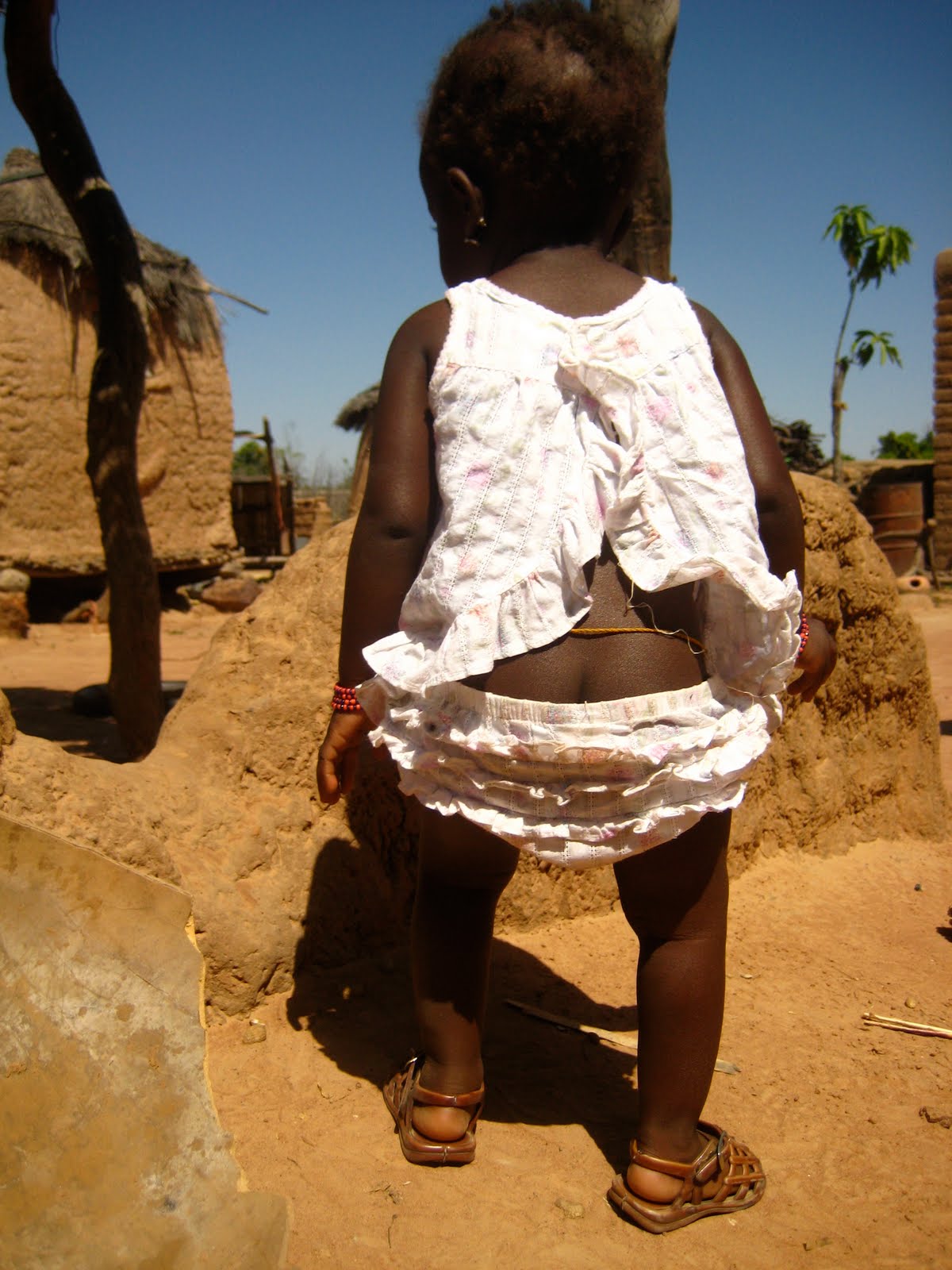
Christine likes to show a little tush when she struts her stuff :)
At a restaurant in San last week a man began speaking to me in between his bites of greasy chicken and rice. I peeled my attention away from the Switzerland-Nigeria World Cup finalizing match playing on the television to make out what he was saying. I operate nearly entirely in Bambara which means even English starts to sound foreign.
"I'm sorry," I say, wanting to give him the benefit of the doubt, "I ko di?" (What did you say?). I watch his lips form the words again and realize I did not mishear - he indeed said "I am a Christmas."
Gaffs often occur with a new language. Embarrassed by the words that feel like marbles rolling around in your mouth it is easy to hold back and shyly abstain from answering questions if you don't know the right word at first. Or, you can dive in and risk making a fool of yourself! After my dinner with this man I began to comb my Malian memories for my own comic blunders. Malians think toubabs are a little off their rockers before you even say hello which makes their quizzical expressions turned belly laughs that much harder to read when I mess up - they laugh at me no matter what I say! Nonetheless, some laughs are more warranted than others and so I've put together a little montage of some of my favorite faux pas in Mali - enjoy!
The first two months of Peace Corps training in Mali are spent in a home-stay village near Bamako where trainees spend 6 hours a day 6 days a week in technical and language training. In the evenings we would retreat to our respective host families to practice Bambara in the relative comfort of a family setting and (hopefully!) with patient hosts. Needless to say your neurons are in overdrive as you learn the structure and idiosyncrasies of a new language while at the same time trying to wrap your head and body around all the cultural and physical adjustments. As I set out on one of my first trips to the butigi (boutique) in Kabe, my home-stay village, I repeated what my host-mom, Korotime, had instructed me to buy: 'buru, den kelen, buru, den kelen' (bread, one piece) while navigating the inadvertent cornfield maze between our mud compound and the shop in the center of town. But by the time I reached my destination all concentration has dissipated as women greeted me and kids chanted my new Malian name - Djelika - and I dodged herds of cows and goats returning from grazing. Once in the store and after greeting the butigi owner I decided to resort to sign language and mumbling - this often gets you at least kind of what you are looking for. 'Boro, den kelen,' I said loudly, as I gestured to a sack stuffed with baguettes by the front door, hoping my higher volume would make up for my faltering pronunciation. He looked at me and then proceeded to empty all the bread from the sack I was pointing to and hand me the empty bag. 'Malians!' I thought to myself, 'why don't they understand!?' I repeated my request: 'Boro, den kelen' a little louder this time as I handed back the empty bag. A look of understanding washed over the owner's face as he took back his bag and handed me a baguette. He once again held up his empty bag and another baguette and said 'Boro' while lifting the bag and 'Buru' while lifting the bread. Not picking up on the subtle nuance I told him that's what I said as I took my change and headed home, glad to be done with my errand. Only later in class as we reviewed food vocabulary was I able to pick up on the not-so-subtle difference between the two words and laugh at myself for the misunderstanding :)
Yawning at my language mistakes :)
Transportation invites miscommunication wherever you are and no matter the language. As Cassie and I emerged from the fray of the main market in Bamako this past summer I saw one of the pick-up trucks-turned-taxis, flat bed converted into seats by three rows of benches, pulling away and in the direction we needed to go. 'Cass,' I yelled as I juggled my bags and held my purse, 'that's our ride!' We picked up speed and I yelled after the truck 'An b'a fe ka jigi! An b'a fe ka jigi!!' making eye-contact with the prend-tigi (moneytaker). The teenage boy handling the passenger's fare cocked his head to the side and then gave the cab of the truck an assertive thump indicating to the driver the passengers crammed in back were ready to go. I cried after them once more but to no avail. 'Malians!' I muttered to Cassie as we absorbed back into the crowd to wait for another taxi. Catching her breath, Cassie wondered aloud, 'doesn't jigi mean to get out of the taxi? I think 'yele' means to get on.' I thought about it for a minute and then dissolved into giggles thinking if a Malian was in America chasing after a taxi yelling 'I want to get out of the taxi! I want to get out of the taxi!' and then cursing unfriendly American taxi drivers for passing him by. Cassie, at this point used to my giggling fits, shook her head and smiled as she pointed out another taxi heading the way we wanted to go. We heaved our heavy bags onto the bed of the truck and hopped in choosing to communicate with our body language rather than actual words.
Little lollipop princess
Toubab status garners a lot of attention from both women and men - but especially men. So it was on the defense that I responded to two guys in the first-class lounge on the river barge Cassie and I recently took from Gao to Mopti. I overheard them say 'Toubabs' and then watched as they, unabashedly, swiveled in their chairs to get a better look and then turn back to their conversation. 'Malian men!' I huffed to Cassie as I turned my attention to the two seated on stools by the bar. 'I be kuma an fe wa?' I asked. While I was sitting down had I been standing there definitely would have been a hand on my hip. One of the men turned back around and laughed. He explained that what I had just said was an invitation to speak with Cassie and I but that surely what I had meant to say was 'I be kuma an kan wa?' (are you talking about us rather than are you talking with us). I couldn't help but chuckle along with him at my mistake.
Sitting at the restaurant last week, motos zooming by and 18-wheeler trucks blaring their horns, I reflected on my own language snafoos and was reminded there is always something to learn - a year and a half in and I still make pretty embarrassing errors! Turning to fully face my new dining companion I gently asked 'Do you mean to say Christian?' eyeing his 'Jesus has risen' print shirt. He nodded emphatically, 'Yes, Christmas!' and turned back to his dinner. At least the holiday isn't far around the corner!
Buy a Nafasoro pump! A few weeks back I committed to something I had been thinking on for awhile. I forked over 37,500 CFA (about $80) to buy a Nafasoro pump produced by the people at Kickstart
and sold throughout Mali at various shops. The pump I purchased was made in Kenya and operates just like a bicycle pump and, once started, is just about as easy to operate. With three people at it, one pumping, one watering and one on hand to relieve tiredness, it is a lot faster and can cover more land than watering by hand from well bags.
The longer I am in Mali the more I realize that for anything to succeed here it needs to be in terms of business and profit. Kickstart seeks to combine fighting poverty with business sense. They understand that people respond to investment and not hand outs. That for development to work there needs to be a sense of ownership on the part of the village or person on the receiving end of that development. I have been curious how the pumps actually work (there are signs for them all over, see below) and so said what the heck, there are worse ways to spend $80.
A sign in San outside one of the shops that sells Nafasoro pumps (there are step ones that operate like a stairmaster = you look real goofy in your garden but have great thighs and a pump one which works just like a bike pump = you look a little goofy in your garden but have great arms).
I'm pretending I'm in America here and that the hose is attached to a faucet...what you don't see is someone sweating at the well! There's a handy attachment that makes the water come out like a spray hose which is great because the pressure from pumping means the water comes out hard and would probably uproot the plant if applied directly.
Annette, Nicole and Kim (working for and doing research with Cornell) came to visit my site to see what it is a Peace Corps Volunteer in Mali actually does... I had a great time sharing with them my home away from home and using my Nafasoro pump for the first time. Thanks for the pictures and the visit ladies!
Here I am sweating away at the pump and hoping someone will come up real soon and ask if they can try.... : )
Cassie came to visit and helped water the okra and hibiscus plants. She was a top-notch waterer and her gardening skills are sorely missed since she had to return to site...
My complete verdict is still out on the Nafasoro pump (Nafasoro means, roughly, "to find a lot!" as in, to find a lot of profit and fruits and veggies). The pump has proven to be frustrating if the tubes aren't tied properly on but with a little patience it gets to working in no time. It is ideal for a gardening association but not just for one person. I'm glad folks are getting a chance to see how it works in my village and though the cost is prohibitive for a family unit (while relatively low, still out of reach for a Malian family) perhaps people will want to band together and purchase one as an association.
Here's a video taken in my garden by the one and only Cassady Walters - thanks Cassie!
See more pictures from Cassie's visit and the shea nut selling session I talked about a few entries back here