You'll actually look forward to your morning commute. Life is calling. How far will you go? Learn more about the Peace Corps

Wednesday, May 18, 2011

The Chief and his Council

Toune mosque, San Region


Afternoon errands
Kadia the potter

Adama Diarra, Toune weaver
 
baby donkey!
The Chief and his Council
After our days spent evaluating multi-age classrooms I spent the afternoons wandering the alleys and paths intersecting and dissecting the villages with my camera around my neck.  I like setting out and not knowing what I'm going to find.  Here are some treasures that fit just that bill.  
The Toune mosque is smack in the middle of super-bush, Mali, West Africa but is one of the fanciest mosques I've seen here in Mali aside from World Heritage sites like the mosque in Djenne.  Women washed clothes behind it in a cement wash area next to a deep well.  Children walked by without looking as they carried pots of water and firewood on their heads.  
Walking to the pump in Toune to fetch potable water for me and the boys (the boys being fellow PHARE-er Moussa, a Ministry official and a guy from the Centre d'Animation Pedagogique - CAP) Kadia saw me with my camera around my neck and hollered at me to come over and take a few shots of her and her pots - big ones - that she sells in market.  When she shouted at me I cringed and thought, eef, is someone just trying to hassle me??  I tried to shake the thought from my head as soon as it entered and headed over to her compound.  As I entered the cleared area in front of her home she opened her hands - a coil of clay rolled in one and a smoothing rag in the other - to show off her work.  What beauties!  And what a reminder to keep my mind and heart open to opportunities like these to meet folks and see something new.
On another trip to the pump (did I mention it's averaging 105 degrees Fahrenheit here - yeah, I drink a lot of water) I heard the fwoomp, fwoomp, fwoomp of Adama's spindle and saw his slowly moving bundle of threads and invited myself over to take a peek.  A wicker basket filled with tiny spindles of carded, cotton thread on Adama's right, a foot loom at center and then yards upon yards of coarse, cotton fabric piled in another wicker basket on his left side.  Kind of incredible to think about what goes into making your own fabric from growing the cotton to picking the cotton to turning little tuft balls into thread to turning it into fabric to dying it to sewing it all together.  Whew.  I'm perspiring just thinking about it.  Well, continuing to perspire that is...
The baby donkey was rolling around being his cute self when I stopped by to say hello.  Didn't you know baby donkeys love having their picture taken too?  
The chief of this Bozo fisherman village is wearing a fabulous, yellow turban scarf overexposed in this photograph.  At the end of each evaluation we spent some time with the village chief and his council talking about what a multi-age classroom is, what they think of the new school in their village and discuss any recommendations they have for the program. Don't you love the look on the chief's face? Most folks said they want an actual classroom built instead of the tarp and thatched roof situation they've got going on, a garden to help the women make some extra money which would then translate to school money for the kids and a well with potable water.  PHARE only works in the domain of teacher training - I just hope sessions like these didn't get their hopes up they would provide more. 
Leaving Toune (one of 4 stops on our San adventure for multi-age classrooms) we pulled our car alongside a nondescript mud hut like the hundreds we passed on our way in and the handful of others we passed on our way out.  As we waited for some fish to be fried and carried back to San I slipped my sandals off and sat on a mat in front of a man pulling and twisting rope - jerky motions and his coil of rope hooked through his toes to keep it from tangling.  I picked up a chubby baby and as I shook her cheeks while I greeted the man to my left.  He didn't respond and so I stopped my cheek shaking to repeat my greetings and saw he didn't hear me because he didn't know I was talking to him - he was blind.  And so I turned my full attention to him, repeated my greetings, and he replied - here doron - peace only.  
I started my nosy list of questions about his rope work - how long has he been doing it? where does he sell the rope? how much is it a yard?  I finally asked his name, Saline Balo, which prompted another question (I'm kind of like the human form of when you give a mouse a cookie) 'i ye mun ye?' - what ethnicity are you (last names indicate ethnicity in Mali but I couldn't place his) and he chuckled.  'Noumou,' he replied.  'Noumou?' I said, crinkling my nose and not recognizing the classification.  'Nga i be kan jumeh fo?' - but what language do you speak?  He chuckled again and replied 'mogo-kan!' - people-talk! - and I had to laugh at myself.  In my effort to put everything I see, hear, taste, smell into categories I can get tripped up in my tidy boxes.  Nice to know that all it takes to get me back in line are experiencing mosques, hands, looms, donkeys and cute old men with turban scarves to remind me I don't need any of those boxes.  After all, we all speak people talk, don't we?

Saturday, May 14, 2011

Ecole a Classe Unique - Multi-age classrooms in Mali

One of the aspects of my work with PHARE involves continued support and evaluation of the multi-age classroom initiative (Ecole a Classe Unique - ECU).  The 35 ECU teachers have now received two trainings on how to manage their multi-age classrooms as well as a trunk of ECU materials.  Now it is time for an evaluation to see how the program is really working on the field and make sure those materials haven't been dropped off in a sand dune in the Sahara desert or traded for tea and sugar. 

The villages where ECUs are established are Isolated - yes, that's with a capital I.  Remote populations off the beaten path (literally).  The ones we've visited thus far in the Sevare region are only accessible by boat during the rainy season and until the rains dry up afterward (usually in January).  These are truly kids who, if there was not an ECU in their village, would never have the chance to go to school.  Pretty powerful stuff if you ask me.    

For the past few days and the upcoming week PHARE staff and Ministry officials are traveling all over the country - from Bamako to Kidal (let me tell you - that's a lot of ground to cover) - to visit all 35 ECUs.  I'm tagging along to get photos and video footage of the action.  Here's some of what we've seen the past couple days:
a multi-age classroomin in the Sevare region.  the black trunk at left is from PHARE and the village constructed the walls of the classroom in a shady clearing next to the chief's home.  this particular village was in love with their teacher.                 "don't let him go back to mopti/sevare where he'll find a wife and never come back - he's too good to lose!!" the chief said.
working on a language arts lesson
Sugu in bambara means market

using old bottles for a math lesson to see if 2 small bottles equals the one large  bottle at left  

  Newly circumcised boys staying in an initiation hut by the river
A Bozo (one of the 12 main ethnic groups in Mali) fisherman village - these are isolated villages! 
What I have seen thus far is encouraging.  The kids are reading and writing with relative ease - a big deal for a Malian student - and even expressing their creativity and imaginations - something else you don't often see here.  

Do you have any questions you have about the ECU program?  I'd love to hear them so I can address them later!

Sunday, May 8, 2011

Happy Mother's Day!

Annie and Christine
Me, Sheri and Lindsay catching snowflakes in a Farm Fresh parking lot :)
Memaw!


Me and Mom at Michael and Courtney's wedding


I have a lot of great Moms in my life - Happy day to all of them pictured here and those who are not, I wouldn't be who or what I am without you!!

Tuesday, April 19, 2011

A yellow dress


N togoma!” – my namesake – I hear shouted from across the street. After carefully stepping off a Sotrama I situate myself, and my overflowing activity bags, on the pavement and I turn my head towards the voice. It is 9:30pm on a Wednesday and I am making my way home from an English lesson in a neighborhood on my side of town. Djelika, my namesake, stops arranging her bowls, buckets and bags – the empty, stackable containers tactile evidence her business selling brochettes and fried treats today was good – and waves me over to join her where she stands in front of a closed motor-parts shop. The amber light from a nearby street lamp casts deep shadows on her precariously stacked pots and pans piled next to a fruit stand where I can buy grafted mangoes and sweet pineapples. “I sigi yan,” she says and gestures to an already occupied plastic chair on the sidewalk in front of her and her pile of bowls. The occupant of the plastic chair rises and relocates to a wooden stool close at hand and Djelika resumes the rinsing of her silver serving bowls. I gladly accept the hospitality, resting my bags on the cement beside me and stretch out my legs.  Balmy night breezes wrap around me as I tuck my dress between my knees to avoid my freshly painted henna. “Wait here for the next Sotrama, n togoma,” Djelika encourages me, knowing what I am here for, “Sooni a be na.”– it will come soon.

Sooni” is a nuanced Bambara word.  It literally means 'soon' but what it often actually means is “be patient, what's the rush?” Etant Américaine – this has been a difficult concept for me to grasp – even after having lived in Mali close to three years. “Sooni” is pronounced “Soh-knee” but is often drawn out to sound like “Sooooooo-kneeeeeee,” the onomatopoeic form echoing itself. Take long enough to pronounce it and maybe what you are waiting for will come soon.
I pass this corner, where my namesake now stands with her empty pots, each Wednesday as I change transportation from a public Bani bus (which has a terminus on this corner) to hail a taxi the rest of the way to the computer center where I teach English once a week. On this corner a group of ladies, like most corners in Bamako, preside over fruit stands and charcoal fires that sizzle under the pressure of large black woks filled with crackling shea and peanut oil. The mouth-watering smells of sweet plantains and seasoned brochettes fill my nostrils as the women yell out “namasa be, brochetti be! Na ka do san ça!” – Bananas here! Brochettes here! Come on and buy some! – as I try to make my way from point A to point B. Sometimes when I pass this corner on my way to class I buy a kilo or two of bananas to share or to use as a vehicle to practice counting (and to have a snack!) during our English lesson. Sometimes when I pass this corner on my way to class I simply wave my greetings and continue on to the center. While I always share greetings and compliments of complets with the women on this corner, and we have obviously shared our names, I have never stopped to sit and wait with them until this evening.
I do not usually make my way home this late at night either. Nor do I usually make the journey back alone. Abdoulaye works at the computer center and participates in my English class, which ends at 6pm, and then we usually share a taxi home. But this month Abdoulaye is in Guinea finishing up work on his veterinary thesis and Aissata, a girl my age who interns at, and lives near, the computer center invited me over for dinner and to do henna. I jumped at the invitation (and may or may not have invited myself!)! After our English lesson I followed Aissata home on foot and sat with her and her cousins as they speed-talked with one another in Songhai, a language from northern Mali. We ate dinner – avocado salad and mangoes, yum!, and I asked for the road home. “Su kora!” – night has fallen! – I pleaded as Aissata encouraged me to spend the night. She eventually conceded that night had indeed come and walked me to the road to catch a Sotrama to Boulkasambougou where the Bani bus dropped me off this afternoon. I thanked her for a wonderful evening and hopped in the bus headed towards my home.

Which is how I find myself, at 9:30pm on a Wednesday, making my way home alone. I am wearing a yellow linen dress I found in sugu kura – the new market – in a pile of thrift store clothes for 400 CFA (a little less than $1USD). When I picked it up and tried it on there in the middle of market I twirled around and thought, “how do folks let go of treasures like these??” before handing over my money and heading back home. The dress has sleeves that hit just above my elbow and a full skirt that ends at mid-calf. With a little black belt and a pair of red, peep-toe flats, the dress makes me feel like an American house-wife from the mid-twentieth century transplanted to Mali in the 21st. One of my American bosses said I looked like sunshine when I wear the dress. Another calls me Dorothy when I wear the red shoes. I love the way the crisp, light linen feels when I walk and how the wind plays with my hemline. A $1 dress from the fripperie and some red flats from Target – my thrills are cheap!

Jabi nena-deh!” – your henna is great! – the ladies sitting around the fruit-stand squeal as I wave my left hand and wiggle my toes to their, and my, delight. I stand up and give a twirl, my yellow dress puffing out around me like a spin top. The women clap but then point out smudges lining the bottom of my dress. I stop twirling and notice what they are talking about. As usual, I moved too quickly and my not-quite-dry henna has smudged onto my new (to me) dress. Bummer! “A be se ka bo wa?” – will it come out? I ask. Some of the women shake their heads no, that stuff is permanent! Then, one women says I should try eau de javel, the watered down bleach I use to clean my vegetables. I hope it works!

Then, my phone rings and it is Bobo, a friend of Abdoulaye's and now mine, on the other end. “Can you still stop by our place tonight?” he asks and I remember – today is Bobo's and Aissetou's 4-year wedding anniversary! “I just need to catch a Sotrama and I'll be there as soon as I can!” I reply. I hang up the phone and bargain with the fruit-stand lady for two piles of mangoes, each one 500CFA, to offer as a gift to Bobo and Aissetou. My reusable bags are at home and so I am left with no choice but to begrudgingly accept a black plastic bag. I settle my newly acquired mangoes among my collection of hand bags and then look at my watch. It is close to 10 o'clock now. I drop my hennaed, and watch-bearing, left hand and look expectantly in the direction of the passing cars. “Sooni I ka Sotrama be na,” my namesake reassures me one more time.

A taxi from this corner to my apartment usually costs between 750-1000 CFA and takes about 15 minutes. A Sotrama, which makes close to the same trajectory but takes anywhere from 20-25 minutes, costs 125 CFA. While American time may be money, Malian time is about saving it and so I continue to wait. After all, won't the Sotrama be here sooni?

But by 10:15 the ladies manning the fruit stands and my namesake are really starting to pack up their baskets of fruit and empty bowls. “Why don't you take a taxi?” they suggest. Extreme disparity in transportation prices or no, it is getting late and I have to agree, a taxi sounds like a good idea. I open my change purse to count out my taxi fare and come up with 275 CFA. Just enough to get home on a Sotrama now and have enough bus fare to get to work tomorrow. Not enough, however, to take a taxi back to my apartment. I realize I have spent my last 1,000CFA on mangoes that are now sitting next to me, teasingly tranquil in their black plastic bag. “I have to wait for the Sotrama,” I explain to the group of women, “n ka waari baana!” – my money is finished! “What do you mean 'waari baana'?” they protest. I explain that while I do have some money at home, I currently do not have money on my person and therefore, unless I can sell back a pile of these mangoes, it looks like I will be waiting right here for my Sotrama. One of the ladies offers to give me a ride on her moto. I have to decline. “Baara-ka yoro sariya,” I explain. Work rules won't allow it.

Then, the fruit-stand lady gets up and offers me 500CFA. “Hohn,” she says. Here. “But I can't accept this!” I try to refuse. The fruit-stand lady and the others sitting around look at me and shrug. “Bassi-ta la, n togoma,” Djelika says as she encourages me to take the money. Don't worry about it. Before I can continue to refuse, she has flagged down a taxi heading in the direction of my apartment and has begun to bargain with him for the price. She leans inside the passenger door and I hear 'N terice, al barika!' – my friend, that's too much! – and my heart swells as this woman with whom I have shared maybe 15 minutes of my life, and mostly in passing, haggles with a taxi-man to get me home and another woman with whom I have barely spoken is giving me my bus fare – and not expecting to get paid back. Djelika waves me over and gives me a grin and a knowing look. “He wouldn't have given you this price if he'd known it was for a toubab,” she says. Then, she presses 100CFA into my hand and says to me, as she opens the passenger door, “a ko keme-ani-mugan” – he says the fare is 600 CFA. Before I can protest that I have 275 CFA with me, and can therefore spot the rest, she has shut the door and returned to the corner. Close to 45 minutes after arriving on this street corner I am on my way home.

I stop at Bobo's and Aissetou's and wish them a happy anniversary. They are a beautiful, young couple and I love listening to their stories about how they met and how their love, which started out as an arranged marriage, has only grown. Have you gotten the impression I am a sentimental person?? After chatting for a bit and handing over the bag of mangoes to Aissetou, Bobo walks me home. I talk about my apartment and what I am thinking about doing in October when my third-year with Peace Corps is up. He talks about the horses he is trying to send his family in Guinea and we both reminisce about missing Abdoulaye. I thank him for walking me home and enter my compound.

Finally in my apartment I slip off my red flats and sit on the bathroom floor, my yellow linen dress spread out before me. The backs of my legs stick to the cold, grey tiles beneath me. My hair, this morning pulled into a somewhat tidy bun, has long since come undone and now lies in plastered strands on my neck. I tug at my dress and notice the smudges of henna have not only found their way onto the hem of my frock but also the backs of my legs. I'm a mess! I take a bottle of diluted bleach and squirt it onto the henna marks. “Will it all come out?” I mutter to myself. “Sooni,” I think. The marks slowly fade to brown and after a few scrubs with an old blue rag, are barely noticeable. Success! I continue to scrub until I have removed all the errant henna – it's a wonder there is any left on my feet and hands considering how much made it onto my dress! I scoot over to the wall and peel off my dress, resting my back on the cool tiles as I close my eyes. I let my mind wander over today's events and find myself getting caught up thinking: how can I pay back all the people who have been so generous with me today? I shift my legs to cooler tiles and wiggle my hennaed feet. At least I have a guiding principle: Sooni.


Monday, April 18, 2011

Lattice-work moonrise

Segou moonrise

Once we leave Bamako, the
landscape opens and swallows
us whole. I'm

breathing in our cold-car air.
Brush fire flickers catch my
green eyes as

the flames lick last year's remains.
Tidy rows of messy black ash
streak by and

the sun sets in a dusty
bed. A raincloud grey sky coats
our world. Then,

at 7 Salif says stop.
Unfold from the car. Dinner
inside! Full

moon shines through rough lattice-work.
Change fish'd from a white bucket.
N faa'ra.

San shadows

Wednesday, April 13, 2011

Peace Corps Mali swears-in volunteers at presidential palace chez ATT

With other volunteers from my swear-in group, September 2008, also
extending to do third-years
(Zac, me, Amber and Dan - Missing are Audrey and Beatrice)


Less than 48 hours after traveling to Libya to engage in (failed) cease-fire talks with Muammar Gaddafi, alongside two other African Union representatives, Amadou Toumani Toure, president of the Republic of Mali, sits calmly on a tan, leather upholstered chair placed squarely in the center of a burgundy rug in his presidential banquet hall. Sitting in front of him, dressed in crisp bazin, embroidered wax prints and business wear are over 400 Peace Corps staff, volunteers, trainees, RPCVs, embassy employees, USAID staff and Peace Corps partner representatives. Peace in the Middle East or no – the swearing in of 61 Peace Corps Volunteers in Mali is not an event to be missed!

Amadou Toumani Toure claps for one of the volunteers who just delivered
a speech in a Malian language
(speeches were given by 5 volunteers in Peul, Malinke, Kassonke, Dogon and Bambara)
2011 marks the 50th anniversary of the Peace Corps and the 40th anniversary of Peace Corps in Mali. Close to 3,000 volunteers have worked, lived, loved and laughed in this country spanning nearly 500,000 square miles and with a current population of about 13 million. This is the first swear-in ceremony I have attended since my own in September 2008 and I was not disappointed. The current ambassador to Mali, Gillian A. Milovanovic, worked to facilitate the grand honor of having the swear-in ceremony on the presidential grounds – way to go Madame Milovanovic!

When Peace Corps Trainees come to Mali they spend two months in intensive training learning Malian languages (depending on where their site will be), taking part in cross-cultural sessions as well as technical training. At the close of training, one volunteer is selected from each of the language groups to deliver a speech at the swear-in ceremony in the language they learned. This year, five languages were studied and therefore five speeches delivered altogether in Peul, Malinke, Kassonke, Dogon and Bambara. All the speeches were beautifully executed and I sat in amazement as the foreign words flowed so easily from the newly sworn-in volunteers' lips after only two-months of (immersed) language training. It made me so proud to be a Peace Corps Volunteer and know that folks are going to be scattered throughout the country already able to form sentences or at least greet in local languages!

At the end ATT was presented with a cake.  And a very large candle.
Somehow seems like this wouldn't fly in the US.
'Here Mr. President!  A cake for you!  And a fire cracker!'
After the speeches by the volunteers, the American ambassador to Mali and the director of Peace Corps Mali, President Amadou Toumani Toure took his turn behind the lectern. He praised Peace Corps and our efforts in integration and language learning. He told a story of going to the States and how his jaw dropped when an American started a conversation with him in his native language, Peul. ATT said, but how do you speak Peul so well? The man said he had been a Peace Corps Volunteer in Mali and then married a Malian woman. “I see,” said ATT. “You didn't travel that far for nothing!” In his speech ATT also stated that the United States has done a lot of good things in the world but, in his opinion, the most important thing they have done for their foreign relations is the Peace Corps. Gave me chills!

He also praised our courage for leaving our homes and the comforts of America to come and live in the harshest conditions even Mali has to offer. “There are Malians who wouldn't go where you go! Coulibaly-kaw b'a la!” In light of the recent world affairs and turmoil in the countries surrounding Mali, with corrupt leaders and dictatorships suppressing the voices of the people, something ATT said struck me. He said, “When you undertake a task, you come to serve others or you come to serve yourself. As Peace Corps Volunteers, you all have come to serve others and I admire and respect you for that.” He went on to say that when he retires from office next year he's going to look into doing the Peace Corps, too.  Peace Corps is looking to increase their 'older' volunteers.  Maybe Aaron Williams, the current director of Peace Corps, could bend the citizenship rule?
Read an article about the swear-in ceremony in French here.
The Kennedys - they're young, handsome and their group has their fair share of intrigue (or so I hear).
It's also the 50th anniversary of Peace Corps begun by John F. Kennedy in 1961
and Peace Corps's 40th anniversary in Mali.  Cute!

Sunday, April 10, 2011

A couple of questions: Peace Corps Mali and 7th graders in Syria

Afternoon transportation
 One of my favorite (ok, there are alot) things about living in Mali is sharing how great Mali is with folks outside the country.  Last week a friend from college, Lauren, who is teaching at the American school in Damascus, Syria sent me an email with a list of questions from her 7th grade students who are studying ancient Mali.  

 Here's a sampling of their very insightful questions.  Thanks for making me think some more about me and Mali!
      2.) Did you like the place you were in Mali before your third year or do you like Bamako better?
      Good question! I like them both but for different reasons. I enjoy Bamako so much because I already speak Bambara (the majority language spoken here even though French is the 'official' language) and understand the Malian culture – all of which I learned in village. Living in village has hard! No electricity, no running water, no internet! But it also gave me a very rich base in the culture, one that would be harder to gain had I lived only in Bamako. I loved living in village and feeling so connected to a family and sleeping under the stars at night without air pollution and speeding cars passing by.
      4.) Are you homesick?  
        Not today! The feelings come and go, as with anything. Sometimes I will get an email from a friend or Skype with a family member and I'll miss being home. It's the small things I miss when I begin to miss home. Going out to lunch. Lounging at home and watching movies with my family. I've been lucky this past year though to have gone home twice and I will go home again in October. Also what helps is that I've had a few friends and my mom come visit so it's not so bad.
      12.) What form of transportation do you use the most?
      My boss usually picks me up for work in her car and then I take a public bus home. Sometimes, if it's not too hot, I bike to and from work on the bike Peace Corps gives all volunteers. After hours I use taxis which aren't too terribly expensive but aren't cheap either!
      15.) What is the best thing about being in Peace Corps?
      The opportunity you're giving to truly immerse in a different culture with a support network behind you. PC provides awesome cultural and language training – no stone is left unturned in either area! They set you up to succeed because with language and culture, you can then try to fit in and develop true relationships with people rooted in understanding.
       5.) Do you want to come to Syria and help?
       What kind of help does Syria need?? :) I'd love to come and visit, that's for sure!
      11.) Did you feel very different once you arrived in Mali and how did you get used to the change?
      I feel like Mali hasn't made me a different person but brought out more of the real me. I've learned so much about myself here – who would have thought I could learn a totally different language and live in a culture completely different from my own?? Of course, there was a lot to get used to as well but being adaptable and flexible are great characteristics to have! 
      12.) What has been your favorite moment while helping people in Mali?
      The chance to live with the people I work (this being more in village than here in Bamako, I have my own apartment here). It wasn't like I showed up at the office, made some decisions and went home. When I lived in village and worked with the shea butter women's group and cereal bank association – those were people I hung out with at night, went to church with, celebrated marriages, baptisms and funerals with. There is such a sense of connection to your work when you know the people for whom and with whom you work.
      16.) Are you happy to answer all of these questions? 
      You betcha! What a great opportunity to reflect on my time here in Mali and to share some of what I've learned with a curious group of 7th graders in Syria!

Tuesday, April 5, 2011

Koulikoro, Mali - regional capital or bust!

See what I mean when I say false bravado? :)
'Est-ce que tu veut aller à Koulikoro le weekend prochain?' Abdoulaye asks me over dinner one night last week. 'Sounds like fun!' I reply. 'À vélo?' he continues. 'Bicycles??' I think to myself; how far are we talking here? The next morning Abdoulaye Googles our destination and sends me a map showing the distance between the capital of Mali (Bamako) and the capital of the region Bamako is in, Koulikoro, as 57 km. I tell Abdoulaye I biked 100 km in 2009 – 57 km (a tad over 35 miles) will be a piece of cake! Abdoulaye brushes aside incredulous commentary from friends that the distance is too far with his winning smile and a dose of false bravado. 'Far?!' he laughingly scoffs. 'Mais on a de la force!' he says as he pumps his lean biceps in the air. After borrowing a bike from our friend Fletcher (thank you!) we add air to our tires, change a flat on mine and pillage my cupboard for snacks (Pringles! Clif bars! Coconut strips!) which we then load into the monogrammed, insulated lunch bag my Mom sent me for my birthday (thank you!). Saturday morning we wake up early and are ready to hit the road.

Morning murmurs of the city slip into our ears and the smells of a Bamako city commute penetrate our noses as we pedal past the city's limits. The racket of honking horns and men shouting at pedestrians to board their commuter bus blend together with the thick smell of hot shea butter oil, fried dough balls and the choking exhaust from cars in disrepair. It is 6:30 a.m. on a Saturday morning and Abdoulaye and I are on our way to Koulikoro, regional capital of its eponymous territory, with enough snacks and water to make it to our final destination 57 km away. L'aventure commence! 

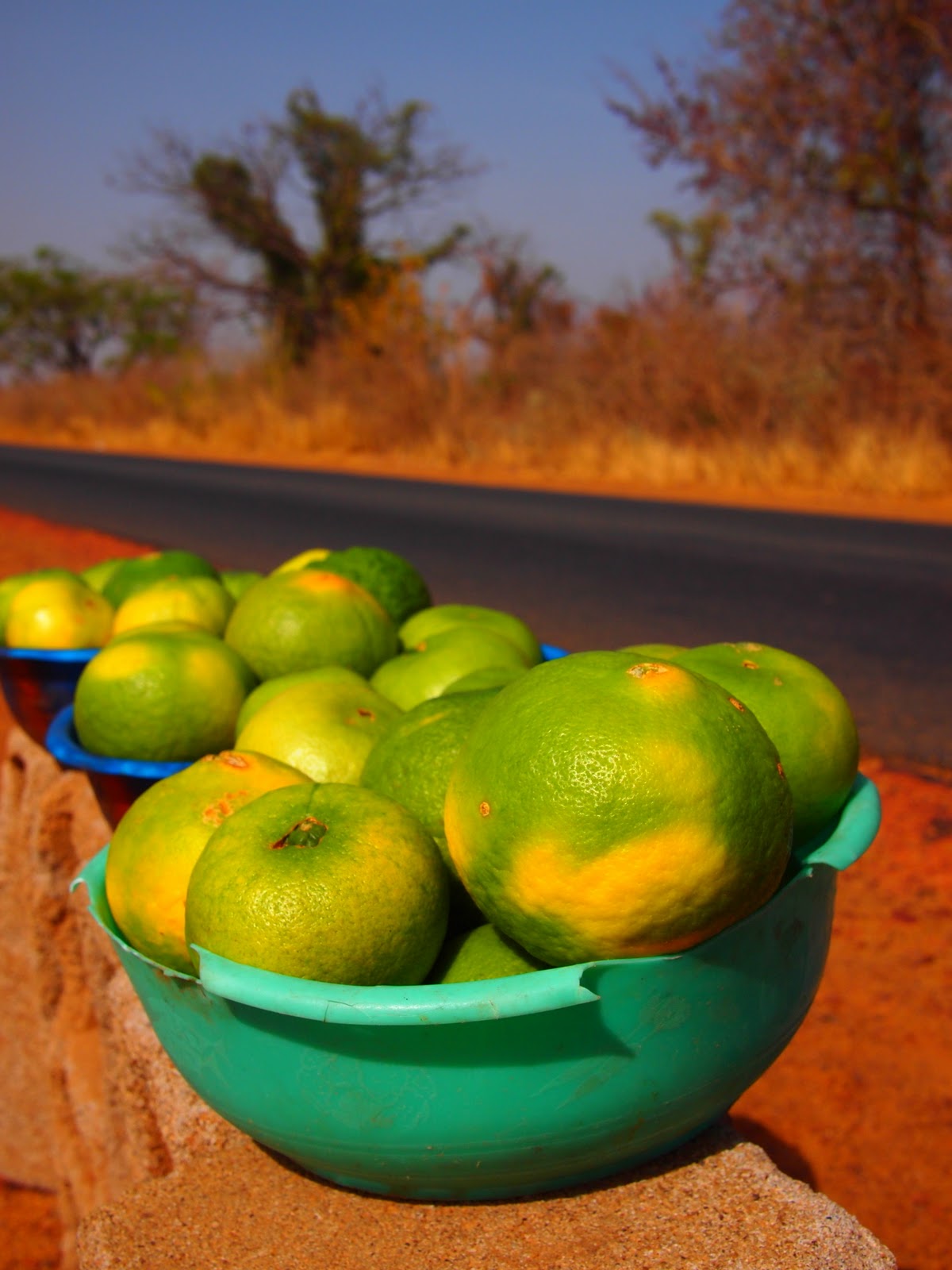
Roadside oranges helped us hydrate
Abdoulaye insists I lead the way and from a few meters ahead I can hear him as he practices his newest acquisition of the English language: 'Let's rub noses like the Eskimo-ses' in between encouragements to bike faster – the sun is rising! I smile and holler back – 'should we stop and put on some music?' 'Ouaaaiii!' he shouts and we make our first pause. We carefully situate our portable speakers in the discarded fruit basket strapped to the back of my bike and finish up the smoothie we brought along for breakfast. With our smoothie, another addition to Abdoulaye's lexicon, all gone and our helmets secured, we continue on. Scraggly trees and piles of trash catch our attention here and there but it is the glimpses of the Niger river and naked rock formations that make us catch our breath.


Hotel, training space, restaurant and cyber cafe
Arriving at the Koulikoro city limits 6 hours after we left Bamako, I sense the fatigue in both our voices and body language. Our water is gone and the snacks we brought along no longer satisfying – our bellies need a real meal! The first hotel we visit, the Hotel du Niger, is too expensive at 15,000 CFA/night (about $30) and too far from 'downtown' Koulikoro for a couple without a car. A friend in Bamako suggested we stop at the Maison du Jumelage to get information about goings-on in town and so we climb back on our bikes and slowly pedal further into the city. The Maison du Jumelage happens to be one of the first buildings we come upon that is actually in the city proper and so we pull in to get the Koulikoro scoop. The Maison du Jumelage is also not just an information center – but also a Maison (house) for sleeping. At 7,500 CFA/night, the price is just right. With lunch being served at their outdoor restaurant as we unload our bikes – their timing is impeccable!


Half-way there!
After filling our tummies with zamé (a red rice served with cabbage, fish and pumpkin) and Coca-Cola, and taking a much-needed nap, we set off on foot to explore the city. It is late afternoon by now but the unrelenting sun makes sweat drip down our backs and encourages us to seek shade on the western side of the street. We stroll slowly as we take in the French, colonial architecture of the city. I purchase 3 meters of fabric with a design of blue and white bath tubs and we buy hermetically sealed bags of water to quench our persistent thirst. We select a side street at random and head east to check out what is happening down by the river. As we make our way to the Niger, thumping music from powerful sub-woofers scream at us from a wedding, children play soccer in an unexpected clearing and Peul women braid one another's fine, sturdy, hair into tight plaits in front of a mud-house. 'Regarde tout ça!' Abdoulaye excitedly remarks, calling my attention to these little moments happening all around us. His joy is contagious – I squeeze his hand and we keep walking towards the red sand and lapping blue waves ahead.
A woman tending to her shell collection to be sold to chicken feed producers
Pedaling into the Koulikoro Abdoulaye and I could not help but notice the numerous abandoned factories with rusting signs lining the entrance to the city. After a few minutes by the Niger it appears their workforces have relocated. Hundreds of men shovel, with water up to their knees, piles of sand from sturdy, wooden pirogues into neat mounds on the banks of the river. The mounds are then collected by large dump trucks and taken to Bamako for use in construction. In the middle of the river, gentle splashes draw our attention to men diving and dredging, with their hands, bucketfuls of sand to be paddled back to shore. Women pull pailfuls of shells in from their own pirogues and lay them out to be dried by tomorrow's sun. One woman explains, as poultry cluck around our feet, that the shells are dried and sold to buyers from Bamako who then grind them to be used as chicken feed. The sun is quickly setting and Abdoulaye and I still need to find a riverside bar another friend said we had to visit. We snap a few shots and find an opening in the piles of shells and sand to reach higher ground.

Photo shoot at one of the abandoned factories
The riverside restaurant described to us as 'a must-see!' turns out to be the abandoned site of a former USAID project that appears to be inhabited by squatters with a refrigerator and a charcoal fire. After dragging plastic-string chairs closer to the river we re-confirm with the disinterested owner that this is indeed a bar and we have not intruded on his home. 'Oui, oui – c'est un restaurant ici!' he replies. We sit for a few minutes and then remind the owner we are there and could we trouble him for some sodas? A sulky woman saunters over to our table and looks at us as though we have interrupted a very pressing activity of hers. She says nothing and so we offer our own questions: 'Vous avez du Coca-Cola?' we ask. 'Non,' she replies and looks down to the mounds of sand that continue to be shoveled by the river. A few moments of silence ensue. 'Pomme?' we continue – apple soda? 'Non,' she answers, her eyes still fixated on the slowly moving piles of sand below. Clearly customer service is not a forté of Koulikoro's hospitality sector. We finally arrive at an understanding after asking well, what sodas do you have? 'Fanta,' she finally concedes. Yes, please – we'll take two! Night falls around us and we sip our orange sodas as we look for tonight's first stars to peek out. Music pours off the deck of an anchored passenger boat nearby. Next on the to-do list for our adventure? River-boat dancing!

All this for only 7,500 CFA/night!
We set our alarm for 11 p.m. and snuggle into twin-sized beds to take a pre-dance party nap. The fan whirls a soothing background noise and I lay my hair carefully around my pillow to keep sweaty strands from sticking to my neck. I nudge Abdoulaye when the alarm goes off a couple hours later and he draws water from the tap to replace the sweat we just expended. We shake the sleep from our bodies and put on our party clothes – the music from the boat now reaches our hotel and is calling us to boogie!

After deciding the dance party on the boat is yet another political rally (we're good on politics for tonight) we follow our ears to a club nearby and also on the banks of the river. Abdoulaye pays 500 CFA (about $1) for his ticket (ladies in free, hoo-rah!) and we slip past the girls flirting with motorcycle-lounging boys outside to enter. Once inside Abdoulaye buys me a warm pineapple soda and we scope out the dance scene. The music is too good to sit still and so I finish what I can of the soda and return the bottle so we can cut the rug. After a few songs, including the African electric slide, and enough giggles to fill a laugh track we take a break on a low-lying wall nearby. Rappers 'de Bamako' clear the dance floor and take turns swaying too and fro with the microphone as they rap in Bambara. We look around the room and decide, at our tender years of 25 and 26, that we are most certainly the oldest people here. The DJ turns on some salsa music and Abdoulaye teaches me some Latin moves. At 1 a.m. we call it a night – we did, after all, bike over 35 miles today – and head back to the hotel with promises to the bouncer that we will return to Koulikoro soon.
Don't be fooled like we were!  The city is still 5km away!
The next morning we sleep in until 11 a.m. and wake up groggy. Maybe hot season was a bad time to bike this far? We settle our accounts at the Maison du Jumelage and bike across town to take a last tour of the city. As we bike through town, a wedding party blasts past us. Hundreds of motos honking simultaneously and some doing tricks. We pull to the side of the road to let them pass and Abdoulaye points to an embankment dividing the river. 'Why don't we bike to the end?' he suggests. We do just that and along the way see an island of goats munching on bright green blades of grass and donkeys sniffing out their own snacks by the river's edge. At the end of the embankment sits a white taxi waiting for folks to cross the small part of the river left open by this mini-dam. We ask the crowd of people waiting under a thatched hanger where the bus station is for Bamako. Our bikes look pretty pooped and so we decide to cut them some slack and let them ride back to Bamako on the roof of a car. We decide we will cut ourselves some slack too and join them. The owner of the white taxi appears and says that Bamako is where this car is headed – and our fare is only 1,200 CFA – cheaper than the Sotrama! 'How much cheaper?' we ask out of curiosity. 'A Sotrama – if you can even find one now – is 1,300 CFA' he replies. Motivated by the big savings and the high-noon sun we laughingly agree. Back to Bamako!

An hour and ½ later, we unload our bikes from the roof of the taxi and carefully cross the traffic-filled streets and train tracks to arrive at the Broadway cafe for lunch. Abdoulaye orders a hamburger for himself, a cheeseburger for me and a Coca-Cola to share. The restaurant's air-conditioning dries our sweat and makes us forget it is well over 100 degrees outside. As Abdoulaye munches on his french fries and I delicately devour my burger we recount our trip from start to finish. Abdoulaye admits that while Koulikoro was great – Bamako does have some nice amenities (like this food!) to offer. We order an ice-cream and I feel my legs ache, asking me for another nap. Abdoulaye grins at me from across the table. 'Where can we bike to next?'

See more pictures from our trip here!

Sunday, March 27, 2011

Closer than you think

I curl my legs beneath me on my brown, black and gray squiggle-stripe couch (I swear, it's not quite so bad looking as it sounds ☺) and select a trashy magazine from the pile of glossy  periodicals on my coffee table.  From the soccer field beside my apartment I hear the static-filled sound check of a PA system cough to life and a bassist strum through a collection of chords.  I set down my magazine, a cloud of dust rising up from the couch cushion, and walk onto my terrace rooftop overlooking the clearing below.  I crane my neck and see groups of Malians arriving in bachées and on foot, descending from sputtering mini-vans and Jakarta-brand motos to arrange plastic lawn chairs in a semi-circle and erect a tarpaulin shelter to protect against the relentless, even in the afternoon, sun.  Women sporting outfits in an indistinguishable-design-yet-certainly-matching fabric test out the microphones, greet arriving guests and prepare the dirt clearing with hand-made straw brooms.  A wedding party?  Another extravagant baptism?  Evangelizing Christians?  The wind catches a white banner and I read the banderole's blocky letters painted with care on a white sheet: 'Union Pour la Republique et la Démocratie.'  No, today we will not be throwing our money into the mouths of hungry griots but rather the empty hands of politicians.  It's a political rally!  

Bamako is no stranger to political rallies and while they are entertaining and certainly colorful with all their wax print fabrics and singing and dancing – it is the protests and demonstrations elsewhere in the world that are capturing the attention of the media.  Lately it is as though the barometer of North African politics is mounting in conjunction with Mali's hot season – la vie commence à chauffer deh! and the barometers of both are rising quickly.    From Tunisia to Egypt to Libya, political landscapes around the world are shifting drastically as people who have lived under dictatorships their entire lives begin to speak out against the injustice of suppression and autocratic rule.  This malcontent is not isolated, as we have now seen, to North Africa.  Middle Eastern countries are playing political dominoes as we watch from afar, and sometimes closer, the toppling of draconian regimes.  One can only hope these leaders will be replaced with  governments that actually represent the interests of their populations and not just the interests of their off-shore bank accounts.

Politics in the Ivory Coast, south-western neighbor to Mali, are not much better than those of the countries to the north.  While the Ivory Coast recently held democratic, multi-party elections, the incumbent president, Laurent Gbagbo, who was defeated by Alassane Ouattara, refuses to hand over the presidency and his control of the Ivory Coast's rich resources (the Ivory Coast is the world's largest exporter of cocoa and home to many other natural resources).  Since the elections in November the United Nations has sent over 10,000 troops to prevent more bloodshed in this country that has barely recovered from a civil war just 10 years ago.  Over 500 people have lost their lives due to this presidential stale-mate and the number of regionally-internally displaced peoples is estimated to soon surpass 1,000,000 – in a country where the population is just over 21,000,000.  1 in 20 Ivoirians are fleeing their homes.  1 in 20 Ivoirians will soon be flooding the borders of neighboring countries and continents.  Is one of them yours?

(image: http://www.diddilydeedot.zoomshare.com/40.html)
Mali is a country situated geographically and politically in the middle of the instability surging in both Libya and the Ivory Coast.  While I have never been better received as an American than while living in Mali – there has been a palpable shift in some Malian's sentiments towards Americans, at least in Bamako, since the implementation by NATO of the no-fly zone in Libya.  Muammar Ghadaffi has invested heavily in Mali and many associate his money with his heart.  It is clear, though, as Ghadaffi continues to massacre his own people that this terrorist has no heart.

And with the Ivory Coast as a direct neighbor to Mali, and the previous allure of employment in Abidjan so high, many Malian friends of mine anxiously await news of their family in Abidjan or are finding room in their homes to welcome back relatives fleeing the thieves and insecurity of the Ivory Coast.  Just last week I noticed 7 Greyhound size buses parked not too far from my apartment and, I later learned, in front of the Mauritanian embassy in Mali.  'Aw be taa min?' I asked.  Where are you going?  'Mauritania,' they replied.  'Nga aw bora min?' I continued.  But where are you coming from?  'Abidjan,' they answered.  The travelers – tired-looking, dusty and surely hungry from such a long voyage – (and only ½ way to their destination) said they were escaping Abidjan, the Ivory Coast's capital, which had recently fallen to banditry and random shootings.

Ghadaffi and Gbagbo are clinging to power in countries where their people clearly no longer want them there.  These autocrats are massacring populations to hold on to authority over a people who have clearly had enough.  When will they finally listen to what not only the international community, but their fellow countrymen, are saying so loudly?  Relinquish your power and pass it over to a leader of, and for, the people  

Orange and Sotelma, two phone-service providers in Mali, broadcast messages from time to time to their customers to advertise for bonus phone credits 'buy 1,000 – 5,000 CFA in credit, get 100% in bonus credit' among other promotions.  They also partner with private organizations such as UNICEF to promote events such as International Hand Washing Day and International Women's Day – 'Journée International de la femme!  Envoyez FEMME à 3757 et recevez un message pour envoyez à toutes vos proches! (300 CFA/message).'    In the car on the way back from a visit from to one of USAID/PHARE's multi-age classrooms, all the phones in the car dinged with their respective text-message indicators.  'Inscrivez-vous sur Facebook pour rester connecter avec vos proches!'  Youssouf, the head of USAID/PHARE's training programs, scoffed.  'Facebook?  Why would I want to subscribe to facebook?  Do they think I want a revolution in my country?!' he said.

Bamako is filled with extravagant mansions, villas with bougainvillea flowers creeping over 10 foot walls and more Hummer and Lexus brand cars than you would expect to see in a country ranking 178 on the UN's poverty index.  Bamako is also filled with people just scraping by, literally, to make a living.  Malians welcomed multi-party, democratic elections earlier than most in West Africa following a coup d'etat on March 26, 1991.  The extreme political instability of the countries surrounding Mali to the North, South, East and West make their democracy  appear all the more outstanding.  But democracy on paper and democracy in practice are not the same.

Have your gas prices been going up recently?  Have you tried shopping in a grocery store in Mali that receives its products via the ports of Abidjan?  The reverberations of the political unrest in countries that seem so far away are closer than we think.  Political rallies, like the one that took place just below my apartment, are on the rise in Bamako with presidential elections projected to take place in Mali in spring 2012.  Maybe that text message from Orange and Soltelma is a prophesy for things to come.  Maybe Mali could use a little more Facebook – and a spoonful of revolution – in their lives, too.
Related Posts Plugin for WordPress, Blogger...

Add this!