Leaving work on Friday, I collect my bag and leave my air conditioned work area to enter the fray of market where steamy heat clings to my skin. I walk down a tree-lined avenue, taxis honking at me to ride instead of walk, towards sugu-ba (the big market) to purchase new sheets to fit my new mattress and a mosquito net. I stop for a snack at a portable vietnamese stand and watch as people narrowly avoid motorcycles and close-cutting taxis weaving in and out of traffic as they navigate their own way to market. I finish my spring-roll treat and, after following the directions of fellow shoppers and shopkeepers down this street and winding back that one, I finally find what I'm looking for.
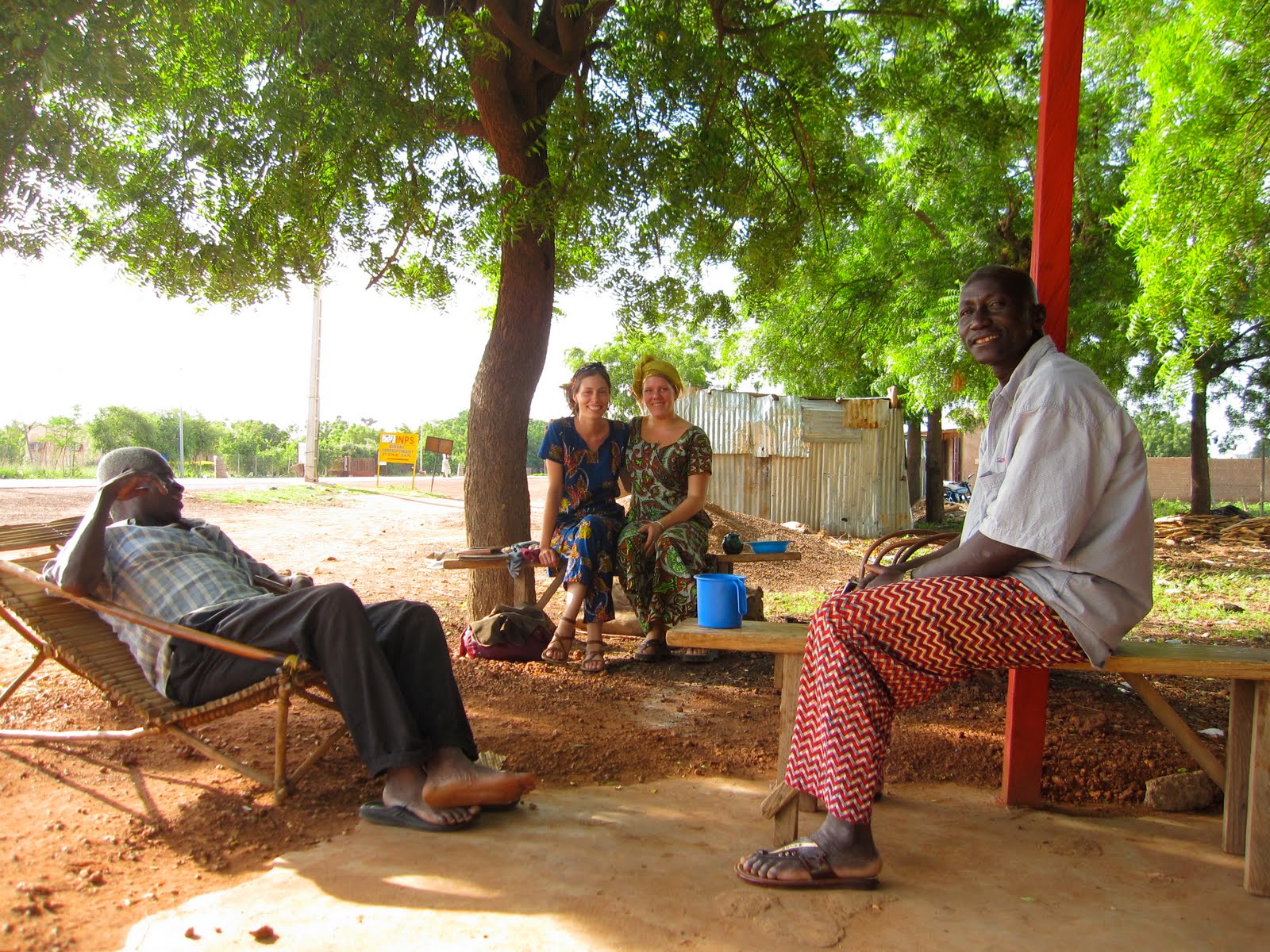
My work space with Almamy Traoré (left and smiling) and Sah Cissé (right and at work!)
The smell of fried dough and open sewers rise up to mix for an unwelcome aroma as I enter the shop. A discreet storefront, one of the few open ones the day after (or of, depending on when you saw the moon) Ramadan where yards of pastel fabric hang from the ceiling and pool together in a single, large, wrinkled mass on the floor. I plunk myself and work bag onto a roughly made plank bench and look around the shop which is no larger than a small, walk-in closet. I quickly see what I came here to buy: a flowing, lace-adorned pink mosquito net and light pink sheets with embroidered flowers. I ask for the net and 3 meters of the fabric to get sewn into a fitted sheet at a tailor near my home.
Outside the PHARE office
A man lounges on a chair outside the door and, nodding towards my bag of embroidered sheets and mosquito net scoffs, 'Pink? It's because you're a feminist.' I look back at him, puzzled, recalling the feminists I know. The shopkeeper comes back with my change and, smiling at the funny observation of the lounging man, I start the walk home as the once threatening clouds begin to pour buckets from the sky. I cringe as I miscalculate puddles and pull my shoulders in under my red umbrella while passing shopkeepers quickly covering their wares with forlorn, plastic sheets. The only colors visible in a once vibrant market are the shiny troops of families returning from greeting for Ramadan in bazin complets (a fancy type of fabric) and new, holiday sandals as they walk quickly to find shelter from the sleeting rain.
A nems stand. Yuumm.
I forgo the teetering Sotramas, filled with passengers dressed for Ramadan celebrations, and decide to walk, even though it's a long way home, because the rain lets up and the afternoon is mine. I turn off to walk behind the main road where kitchen gardens line the mud paths and guards in maroon uniforms and matching caps sit in plastic lawn chairs outside villa walls. The air is decidedly cleaner only one street off the main road - fresh vegetable smells replacing the stifling odor of unfiltered exhaust. For a minute I'm transported out of Bamako and back to village where bending millet stalks and flowering okra line the paths to village rather than crumbling sidewalks and gaudy home furnishings.
I follow the rising spires of the large mosque near my home to find my way in the maze of intersecting, muddy roads. My neighborhood is characterized by large, shady trees and as I near my home I fold up my umbrella and let the rainy season breezes and afternoon sun wrap around me. Mining offices and small hotels are interspersed with tiny hardware shops, tailors and egg-sandwich stands in the area. I dodge errant soccer balls kicked by little boys in Spanish soccer jerseys and greet groups of women braiding hair outside metal lean-to beauty boutiques. I climb the tile-mosaic stairs to my apartment, gauzy net and cotton-candy pink fabric spilling out of my overflowing bags, and collapse on my couch. I turn on the ceiling fan and close my eyes as the afternoon call to prayer pours through my windows.
Tuesday, September 14, 2010
Tuesday, September 7, 2010
My work in Bamako - In honor of International Literacy Day (September 8)
A week ago I moved from a village with a population of 1,000 to Bamako - a city with a population of over 1,000,000. I moved from a mud hut where branches reinforced my roof and I used an outdoor latrine to a cement house with indoor plumbing, ceiling fans and electricity. Instead of working with farmers and a women's group, I work with the Programme Harmonisé d'Appui au Renforcement de l'Education (PHARE), the Ministry of Education and USAID employees. Instead of biking 15 miles to get fresh food, I hop on a Sotrama (the public mini-bus system where you pay 125 CFA/ride - about 12 cents) to pick up fresh vegetable and household supplies from open markets and shops on the way home from work.
PHARE is a $30 million program funded through USAID that coordinates with the Ministry of Education to improve the quality of teacher training in Mali through direct teacher training, radio broadcasts, smart phones and virtual training centers. I will not be teaching students but rather assisting in the development of lesson plans, teacher training manuals and communication/public relation materials.
This past week I took part in a number of meetings. One of them was with the 17 directors of the teaching academies of Mali where I listened to one of my bosses, Rebecca Rhodes (an RPCV from Guinea), report on the work PHARE completed during the 2009-10 school year and what the program hopes to accomplish (in coordination with the directors) in 2010-11. Later in the week I sat in on training-schedule development meetings and made a visit to a village 70 km from Bamako where PHARE is monitoring the success of the one-room schools the ministry is promoting throughout Mali (it was a long and bumpy ride that my stomach couldn't handle!) One-room schools are implemented in villages where the child population is under 40 and one teacher teaches grades 1-6. It has been applied to schools around the world with great success.
In Mali, public school begins in early October. The interactive radio programs PHARE has produced, the primary tool for reinforcing French literacy skills, are 30 minute lesson plans and will begin to broadcast in mid-November. The interactive radio programs provide teachers with learning tools on how to teach (over 1/2 of teachers receive NO formal training) while simultaneously helping students to learn French which they need if they want to be competitive in either the national or international job market later on and also for their own educational development.
See and hear what interactive radio programs are like in Somalia
Statistics show that by the end of grade 4 in Mali, only 23% of boys and 10% of girls can read a simple sentence in French. Mali ranks at the bottom of the United Nation's literacy rankings. Can you imagine sending your child to school and them not learning the alphabet until the third grade? That's what happens in Mali. Can you imagine sending your child to school to share a classroom with 100 other students and one teacher? That's what happens in Mali. Can you imagine sacrificing an extra pair of able hands on your farm and paying for your child's education only to have them come home having learned nothing? That's what happens in Mali. After witnessing the fervor with which Annie and Esayi pursued their own children's education in village, having received limited education themselves, I feel the pressing need for an improved education system in Mali. Quality education produces people who are able to inform themselves on civil issues and creates an informed voter base who can then elect quality, non-corrupt leaders which in turn leads to an improved economy and internal infrastructure which then overflows into all aspects of social and economic development.
I feel blessed to have spent 2 years living in a rural village where Annie, Esayi and my neighbors taught me about life in Mali (and also for the public education I received in Virginia!). I am looking forward to applying the cultural lessons learned in village to an office setting in Bamako and towards work I truly believe in. I have engaging and interesting bosses and colleagues, stimulating work and a beautiful National Museum to visit during my lunch breaks. While my job description has changed and I will play in a lot less dirt than I did in village (with 999,000 more people around), my reasons for being here are the same. I live in a beautiful country with warm, welcoming people and I have work that challenges and inspires me. Allah k'a i deme!
PHARE is a $30 million program funded through USAID that coordinates with the Ministry of Education to improve the quality of teacher training in Mali through direct teacher training, radio broadcasts, smart phones and virtual training centers. I will not be teaching students but rather assisting in the development of lesson plans, teacher training manuals and communication/public relation materials.
This past week I took part in a number of meetings. One of them was with the 17 directors of the teaching academies of Mali where I listened to one of my bosses, Rebecca Rhodes (an RPCV from Guinea), report on the work PHARE completed during the 2009-10 school year and what the program hopes to accomplish (in coordination with the directors) in 2010-11. Later in the week I sat in on training-schedule development meetings and made a visit to a village 70 km from Bamako where PHARE is monitoring the success of the one-room schools the ministry is promoting throughout Mali (it was a long and bumpy ride that my stomach couldn't handle!) One-room schools are implemented in villages where the child population is under 40 and one teacher teaches grades 1-6. It has been applied to schools around the world with great success.
In Mali, public school begins in early October. The interactive radio programs PHARE has produced, the primary tool for reinforcing French literacy skills, are 30 minute lesson plans and will begin to broadcast in mid-November. The interactive radio programs provide teachers with learning tools on how to teach (over 1/2 of teachers receive NO formal training) while simultaneously helping students to learn French which they need if they want to be competitive in either the national or international job market later on and also for their own educational development.
See and hear what interactive radio programs are like in Somalia
Statistics show that by the end of grade 4 in Mali, only 23% of boys and 10% of girls can read a simple sentence in French. Mali ranks at the bottom of the United Nation's literacy rankings. Can you imagine sending your child to school and them not learning the alphabet until the third grade? That's what happens in Mali. Can you imagine sending your child to school to share a classroom with 100 other students and one teacher? That's what happens in Mali. Can you imagine sacrificing an extra pair of able hands on your farm and paying for your child's education only to have them come home having learned nothing? That's what happens in Mali. After witnessing the fervor with which Annie and Esayi pursued their own children's education in village, having received limited education themselves, I feel the pressing need for an improved education system in Mali. Quality education produces people who are able to inform themselves on civil issues and creates an informed voter base who can then elect quality, non-corrupt leaders which in turn leads to an improved economy and internal infrastructure which then overflows into all aspects of social and economic development.
I feel blessed to have spent 2 years living in a rural village where Annie, Esayi and my neighbors taught me about life in Mali (and also for the public education I received in Virginia!). I am looking forward to applying the cultural lessons learned in village to an office setting in Bamako and towards work I truly believe in. I have engaging and interesting bosses and colleagues, stimulating work and a beautiful National Museum to visit during my lunch breaks. While my job description has changed and I will play in a lot less dirt than I did in village (with 999,000 more people around), my reasons for being here are the same. I live in a beautiful country with warm, welcoming people and I have work that challenges and inspires me. Allah k'a i deme!
Saturday, September 4, 2010
Annie's pre-natal consultation in Mali*
When I returned from America in July I saw Annie for the first time in over 1 1/2 months (due to COS conference and my sejour home) and I immediately noticed that her belly - though not the rest of her - had grown significantly. While it is culturally inappropriate in Mali to reference a woman's pregnancy (for fear of jinxing the pregnancy) I asked Annie about her bump to which she laughed and said there was a baby waiting inside to come out! She said she needed to go to the health clinic to receive a tetanus booster and her pre-natal consultation and I asked if I could tag along. Vaccinations are issued each Tuesday (for babies and expectant mothers) at our local health clinic 2 km away so we decided to go the Tuesday before I left.
Tuesday morning I saw Annie buzzing around the compound with more haste than usual. The cooking/preparing/pounding of the millet for meals rotates every two days between the three wives in the compound (Esayi's wife Annie and his two younger brothers' wives Aminata and Kadia) and though Annie would have preferred to go to the clinic on a day when she wasn't cooking- the task the most time sensitive, and consuming, since a whole family of bellies depends on it - the vaccination day fell on both of the following Tuesdays and so we were obliged to choose one of them. Also, harvest will pick up soon so Annie wanted to get the trip out of the way before she is needed more in the fields.
Annie walking to the health clinic with her knitting in hand
Walking to the clinic Annie worked on her knitting as I struggled to keep up while wearing a skirt and avoiding mud puddles. Along the way we picked up women heading in the same direction for their baby's vaccination (4 weeks - 9 months) but most didn't move as quickly as Annie so they would fall behind. Upon arrival, Annie sat down on the edge of the concrete platform between the mid-wife's consultation room and the vaccinator's area to wait for the mid-wife to usher her inside. She situated herself directly in front of the door leading to the mid-wife's office to avoid confusion as to who got there first. Annie, like myself, doesn't put up with line cutters!
The door finally opened after waiting for 1/2 hour and Annie and I went inside . The mid-wife then spent 10 minutes looking for papers on her unorganized desk and the notebook in which she enters all the names of the women who come to receive her services (she delivers it to the health center in San at the end of each month). The mid-wife's toddler daughter was running around the room picking up stethoscopes and jumping on the scale and I felt myself sighing and shaking my head as I saw Annie waiting patiently. Even though Annie is paying for this service she doesn't feel she has a voice to express dissatisfaction when the care provided is inadequate and untimely - and who would she complain to anyways? After Annie signed her name in the now located notebook the mid-wife directed us to the pharmacist (a room just outside the size of a closet where items like birth control pills, condoms, multi-vitamins and iron supplements are sold). Annie paid the man 1,750 CFA (about $3.50 USD) to receive three papers (and other supplements) - two papers to track the baby's vaccinations once it is born (one for Annie and one for the health records/donor agencies that subsidize the clinics) and one to track her own shots, weight and height. Annie also received a malaria prophylaxis, iron supplements, a mosquito net, her pre-natal consultation and a tetanus booster. When her baby receives all of its vaccinations (after 9 months) she'll receive another mosquito net. Back in the mid-wife's office Annie was weighed and her height taken (49 kg=108 lb. and 1.5 meters=5 feet). She said this was a 9 kg increase from her last pregnancy (baby Christine) during which she got very ill.
The mid-wife's desk - you can tell she had a hard time finding Annie's papers!
Mosquito nets
After finishing up with the mid-wife Annie and I headed over to the vaccinator's room and Annie worried to me that he wouldn't have time for her. I reassured her that all expectant mothers are taken ahead of the baby vaccinations (over 40 women were waiting for their baby's vaccination) and that all we needed to worry about was if there were enough vaccinations. There were and Diabité took us in not long after. While Annie collected her papers and knitting, I purchased bread and onion sauce for 50 CFA (about 10 cents) from an entrepreneurial child marketing her wares to the hungry, breast-feeding mothers waiting (and the snacky toubabu :) On the way home Annie and I munched on our bread and talked about her visit. She was happy with her weight and how she's been feeling during this pregnancy and began talking about what we were making for lunch - saga saga - and how we needed to get back to get started and also beat the ominous rain clouds ahead.
Annie and the vaccinator, Diabité, before she received her tetanus booster
The waiting area of the health clinic with women waiting for their baby's vaccinations who walked anywhere from 0-10 km to get here
As I write this from my new place in Bamako I realize this is what I'll miss most about living in village. The one-on-one moments where I feel such a part of someone's life. Going to Annie's pre-natal consultation, planting trees with Bakari, moringa with Dramane and visiting gardens of people I know and with whom I have a real connection. These interactions will be difficult to replicate in big, impersonal Bamako but I'll strive to achieve them nonetheless.
*While with Annie I took notes & pictures on the process but asked for her permission to write and publish this on my blog. She agreed wholeheartedly.
Tuesday, August 31, 2010
K'an sooni!
On Friday at dusk Modibo, a Peace Corps driver, turned the familiar corner of the mud-wall lined path outside my hut to arrive at Esayi’s compound. Modibo, along with Esayi, Bakari and a handful of other capable, strong, young men, loaded his white SUV with all the treasures I accumulated in village the past two years. Tables, chairs, trunks, suitcases, pots, pans, a bike, a gas tank and stove all piled creatively into the back and top of the truck. Waati sera! The time has come!
Esayi and I in front of my house
I spent the last two weeks at site throwing out papers, packing my belongings and saying my goodbyes to folks. After knitting with Annie through the heat or rain of the day I would strap Christine to my back and head from compound to garden, garden to compound and greet people and explain one more time that soon I would be leaving and soon a new volunteer, Jim (AKA Adama), will arrive. Women would look up from sifting millet flour or corralling a child to say, ‘eh, kelen??’ – Already??. I would laugh and say two years isn’t already! Old men would grin or frown, offer one their hand (or their oldest sons’) in marriage one last time and say ‘eh, an be deli ka soro i be ta’ – Just as we get used to one another, you go. It’s hard to imagine it taking so long to truly feel a part of somewhere and in truth, I’ve felt a part of the village for much longer. But the comfortable interactions, the greeting and knowing people’s names and their families, the knowing where to go in village for milk powder, dried fish, batteries and flour – that really did take a long time and even up until the last week I continued to learn about the village and its varied dynamics.
Christine getting ready for the party
Esayi and Annie agreed it would be best to have a farewell party the night before I left. On the Monday before I sent money with Esayi to the San market to buy sugar, tea, cigarettes and gasoline for the fête. Annie met with the women’s association a few weeks earlier to discuss renting strip lights, speakers and a generator. Wednesday night I sat down with Annie to knit and Baissata, the president of the women’s group, joined us so I offered her my chair and sat behind Annie on a low-lying mud wall. They began to speak quickly and I followed words, expressions and body language to figure out my party had some problems. Annie said the woman in charge of coordinating the lights and speakers forgot to rent them. ‘An be na mun ke?’ she asked me. What will we do? I shrugged, and said well, no party? I didn’t know what to say or what to do. Disappointed, I left to make a phone call and when I returned Annie said we had another problem. I smiled and said let’s hear it. She said Baissata had come back to tell her an old woman in village died. That her funeral would be tomorrow, Thursday, the day before I leave. In my village, where animism is a predominant religion (akin to spiritualism), the whole village is expected to go out to the fields and bury the body together. And so, after greeting the family of the woman in the morning, we all headed out to the fields to bury her body and dance next to the grave. That night heavy rains came and the celebration of her life didn’t start until 3 am. I woke up at 5:30 and headed over for the last song, just before dawn. While not having a party was too bad, I’m not really leaving yet and so we’ll save the party for another visit (in ch’Allah!) and hopefully we’ll have a good time then.
A rainy season sunset as I bike into site for the last time
Modibo got in the truck, anxious to get back to San to break the fast of the day (it is Ramadan) and Annie and Esayi quickly said their farewells: ‘Allah ka sira numan ye; Allah ka nogon ye nogoya.’ for a blessed my trip to Bamako and a quick return to Zana. A small crowd had gathered around the truck to witness the hubbub and as I looked back, Modibo’s white SUV leaving the way it came but with me in it, I saw the small crowd dissolve as night began to fall. The men to Shaka’s for tea and talking. The women back into their compounds to take care of dinner and wash the kids. The children chasing after old bike tires with sticks in the well-worn ruts in the road. After two years it’s nice to know that while some things have changed because of me, (hopefully for the better) life here is the same. Waati sera.
Two of the treasures I had to leave behind
Thursday, August 5, 2010
Fumbles, Food and Fun!
When writing my blog posts I often feel like waving my arms around me and saying, 'See??!!' because my words fail me. I spent these past 3 weeks waving my arms around and saying 'See??!!' but it was to a friend. I spent these past 3 weeks talking until I was blue in the face but it was with someone next to me. Exploring Mali with one of my best friends, Sarah, we talked about our lives in Mali and France and she got to see the country she's been reading about for 2 years on my blog in person. Seeing her nod and get a real grasp on my life here was touching and an incredibly rich experience for us both.
Sarah and Maridee checking out mud cloth in Koutiala
The day after arriving in Bamako and staying at my friend Ryan's place (thank you!) Sarah and I loaded into an NGO pick-up truck with my overweight bags and her carry-on size suitcase and headed to Koutiala. Once there we relaxed at the volunteer house and tried to catch up on some sleep - I was pretty fuzzy after a 12 hour flight and a bumpy truck ride. The next day, watered and fed, we headed with Maridee, another PCV who is based in Koutiala, to the mud-cloth association where she works. We learned where the dyes come from, how the mud-cloth is made and some of the history behind the designs before making some purchases and taking a few lovely pictures.From Koutiala we traveled to San in a friendly mini-bus where the other passengers loved Sarah (of course!) and taught her lots of things in Bambara in between questions about her man and reasons for being in Mali. In the span of the few days we spent in San Sarah learned to greet in Bambara, purchased many bolts of fabric to be made into gifts and matching outfits and ate a large amount of peanut-butter-sauce-covered rice. While passing through a plastic-sheet covered stall in the fabric section of market an old, frail man took one look at me and Sarah and made me promise I would take her inside in case of strong winds to prevent them from blowing her away. I happily agreed and Sarah nudged me to say the same about him!
Tea at Uncle's (left) was a mainstay of our visit to San
After biking the 20km to village (it's part of the travel ritual :), Sarah finally got to give baby Christine snuggles, Annie hugs and Esayi confirmations that yes, she was in good health and happy to be here. We collected shea nuts with Annie one morning, tried to help pound millet into flour, toured the village to meet all of my friends and folks I work with and spent a morning in the cereal bank as the last of the grain was issued to families in my village. Sarah is a trooper biking through the marsh from my village!
We were then honored to attend Cassie's farewell party at her site and next headed to Djenné to see the largest mud mosque in the world on Djenné's market day. The mosque is pretty much all there is to see in Djenné so after a day there we headed to Mopti and stayed with a volunteer, Susan, (thank you!) and then to Sevaré where we purchased treasures (of course!) and prepared to leave for our Dogon hike. The 3-day Dogon hike took us on a beautiful tour of the lush cliffs with breathtaking views of the encroaching desert and scrubby brush below for only 8,000 CFA/day (about $16) from Dourou to Telly. Checking out the scenery in Dogon country
Carefully navigating the rocky terrain ahead of us I lagged behind the group on our Dogon hike. I heard Oumar Guindo, our sailor-mouthed guide and comedian for the trip, holler back to the rest of us 'Got it?!' after his inaudible commentary on the landscape around and below. I waved my arms around and said 'See??!!' to Sarah and she turned back and smiled. I have been truly blessed to have Marija, my Mom and now Sarah come and share in my experiences here and actually see for themselves this beautiful country and the people I know (and all the ones I've yet to meet!) in it. Because when it comes to Mali - sometimes there just aren't words.
Wednesday, July 14, 2010
Dolphin fins
Lying on the beach in Sandbridge I rolled over under the shade of my beach umbrella to look out at the ocean and dig my toes in a new patch of cool sand. A lanky man in swim trunks with an uneven tan stood next to me and my group of college girlfriends as he filmed the slowly moving waves and the steady trail of dolphins making their way South. He narrated his film for the folks back home: "Here we are in Virginia Beach, Virginia!" and as a group of fins broke the surface he sighed and said "Do you see those fins - this was worth the 12 hour drive!" My friends and I turned to one another and raised our eyebrows. That's a long way to travel for a couple of dolphin fins.
I returned to Virginia Beach, Virginia for one month for my brother's wedding after living in Mali, West Africa for two years doing work as an environment volunteer with the Peace Corps. I flew into Dulles airport in Washington, DC on June 12 where my mom, brother and sister-in-law were waiting for me and I didn't stop moving until my sister dropped me off again at Dulles airport July 12. Two years of missed birthdays, holidays, lunches with friends, concerts, weekend trips and hugs from my family and friends made for a lot of catching up to do! I felt privileged to be home and attend the bachelorette party, bridal luncheon, rehearsal bowling and to be a bridesmaid in the wedding with my sister Lindsay.
After the wedding I headed North to Boston with Dad, Sheri and Lindsay to tour Tufts University and visit my best-friend from college, Marija. While in Boston we ate scrumptious food and toured the city including a visit to the Boston common gardens, the seals at the aquarium, Paul Revere's grave and some shopping. On our way back down to Virginia Beach we stopped in New York City to see James Taylor and Carol King live at Madison Square Garden where they performed songs I've heard all my life to a sold-out crowd of 20,000.
Back in Virginia Beach I spent the 4th of July with Mom and John where we snuggled on our couches after the neighborhood parade and picnic and watched the firework shows on TV live from DC and Boston. We beached it the next day and I enjoyed watching them both turn different shades of pink from under the shade of my umbrella. Mom, John and I spent our evenings eating delicious dinners and I spent my days exercising with Memaw and then meeting Mom for lunch.
Looking back on my trip I think of that man on the beach and the dolphins recorded on his family video. How quickly one month goes by but how much I was able to do. A beautiful wedding, concerts with family and friends, lunches with favorite teachers, celebrations and delicious meals. Thank you to everyone who made my trip home so special - this was more than worth the 12 hour flight!
I returned to Virginia Beach, Virginia for one month for my brother's wedding after living in Mali, West Africa for two years doing work as an environment volunteer with the Peace Corps. I flew into Dulles airport in Washington, DC on June 12 where my mom, brother and sister-in-law were waiting for me and I didn't stop moving until my sister dropped me off again at Dulles airport July 12. Two years of missed birthdays, holidays, lunches with friends, concerts, weekend trips and hugs from my family and friends made for a lot of catching up to do! I felt privileged to be home and attend the bachelorette party, bridal luncheon, rehearsal bowling and to be a bridesmaid in the wedding with my sister Lindsay.
After the wedding I headed North to Boston with Dad, Sheri and Lindsay to tour Tufts University and visit my best-friend from college, Marija. While in Boston we ate scrumptious food and toured the city including a visit to the Boston common gardens, the seals at the aquarium, Paul Revere's grave and some shopping. On our way back down to Virginia Beach we stopped in New York City to see James Taylor and Carol King live at Madison Square Garden where they performed songs I've heard all my life to a sold-out crowd of 20,000.
Back in Virginia Beach I spent the 4th of July with Mom and John where we snuggled on our couches after the neighborhood parade and picnic and watched the firework shows on TV live from DC and Boston. We beached it the next day and I enjoyed watching them both turn different shades of pink from under the shade of my umbrella. Mom, John and I spent our evenings eating delicious dinners and I spent my days exercising with Memaw and then meeting Mom for lunch.
Looking back on my trip I think of that man on the beach and the dolphins recorded on his family video. How quickly one month goes by but how much I was able to do. A beautiful wedding, concerts with family and friends, lunches with favorite teachers, celebrations and delicious meals. Thank you to everyone who made my trip home so special - this was more than worth the 12 hour flight!
Monday, July 12, 2010
Some are the melody and some are the beat: my trip home in pictures!
Michael and Courtney sharing their vows at 73rd street in Virginia Beach
June 26, 2010
The bridal party
A Sister Hazel concert at 31st park with Anna, Amanda and Ann and drinks at the Sky bar Hilton - thank you so much ladies for coming to Virginia Beach!
A great trip to Boston to visit the sweet and talented Marija!
Checking out the dolphins at Sandbridge beach
Tercet(!)
Jackie the treasure - I really am blessed to have so many great friends!
Michael Bublé in Norfolk - he's so flat in real life!
See more pictures from the wedding here
See more pictures from my time home here
Thursday, July 8, 2010
Feeling grainy: a cereal bank in my village
Before: Day one of work on the cereal bank
In Mali the principle grains are millet, sorghum and rice. With these grains women can make the staple dishes of Mali: toh (like firm mashed potatoes), siri (a porrdige) and rice dishes. Cereal banks are constructed by villages and NGOs (non-governmental organizations) to help ensure food security in places where the fluctuations in the grain market are most deeply felt (i.e. small villages where jobs, and therefore income, are scarce). According to the USAID website “Food security means having, at all times, both physical and economic access to sufficient food to meet dietary needs for a productive and healthy life. A family is food secure when its members do not live in hunger or fear of hunger." Food security are two big buzz words in Mali right now and millions of dollars from USAID and the United Nations pour into the country to combat the effects of food insecurity and help to provide food security.
making progress!
The way a cereal bank should work is a family comes to the cereal bank council (selected by the chief of the village) and pays a joining fee in CFA (the currency in Mali) or with 20 kilos of grain. Then, when hungry season arrives -typically from August-September – the family can take out 100 kilos of grain to get them through and pay the 100 kilos of grain back after harvest with interest i.e. 120 kilos of grain total. Hungry season is the time of year when farmers work their hardest to tend to their fields but their personal grain banks empty before their own harvest is ready thus leaving the family without enough grain at a time when there is no money to buy more.
These are what personal graineries look like. (from Esayi and Annie's compound/yard)
In the fall of 2009 a group of 6 men including Esayi, the chief of the village and my host-dad, drafted a budget for our village's cereal bank. The budget included requests for funds to cement the floor and walls, iron for the roof, a door with locks and forty-five, 100 kilogram sacks of millet (about 220 pounds each). After the men drafted the budget I transferred the proposal to an Excel spreadsheet and filed the necessary paperwork to receive a Small Project Assistance (SPA) grant for close to one million CFA (about USD $2,000) from the Peace Corps. SPA grants require a community contribution of at least 33% which our village contributed in the form of labor. The men hand-made the bricks, transported them to the building site and built the cereal bank for free. We also drafted a time-line for the construction and use of the cereal bank.
This bike is just a restin' its bones
The men took a few months to construct the cereal bank and finished it near the end of April after a ground-breaking in February. After the completion of the bank an agriculture technician from our area came to deliver a 3-day training on how to manage the cereal bank and keep records of the debits and credits to the bank. Esayi and I then spent a few week gridding and painting a map of the world onto the front of the bank.
Breaking ground - I didn't last long!
The painting on the front of the cereal bank struck me at first as an incongruous location for a map of the world. Perhaps it would have been better to paint a mural about nutrition or good farming techniques but I'm not an artist and there is nothing like seeing someone experience the vastness of the world through a map as I witness when villagers pass by and marvel at the distance and proximity of countries to one another. What better way for Malians (and me!) to learn where the countries are they hear about most: the USA, Spain, France, Canada, China and other West African nations? What better way to generate discussions about where all this development money is coming from to help ensure food security? The map on the cereal bank reminds me why I live in Mali and do what I do. I live, and have stayed, in Mali because I have grown to love the people and I have grown to love the country. The map on the cereal bank reminds of that and the grain inside also ensures that Annie, my host-mom, can make toh for me and her family all year.
Esayi seals up the cracks inside
the final product!
After: Esayi gives a tour in Bambara of the new cereal bank in our village. He's a great host!
See more pictures from the process here!
Monday, June 21, 2010
Moringa with Djelika!
Esther and Cassie came out to my village and helped me make this video; enjoy!*
One of the mini-projects I've worked on as a Peace Corps volunteer in Mali is the cultivation of the Moringa tree. I've planted about 10-15 in my yard and then walk around village giving seeds to folks who are interested (and able to plant them where goats won't eat them). Dramane, one of the more successful farmers in my village, planted about 30 of them last year in his garden and they've taken incredibly to the dry, sandy soil. Some additional uses of the tree include live fencing, wind breaks in fields and fodder for livestock.
Moringa can do so much! In order to avoid plagiarism, I'll direct you to a great site where you can learn even more about the incredible properties of the Moringa tree:
Moringa.com
Dramane, one of the farmers in my village, planted these moringa trees in April 2009 from seed! This photo was taken in June 2010.
Here Batuma is sifting the dried, pounded Moringa leaves
*Since I'm home in America for the next month I have the luxury of speedy uploads and so will be putting up some videos that would take too long to download in Mali.
Monday, June 14, 2010
We took the Philly flight headin' Mali bound!
To celebrate our close of service we put together a song and dance routine to the beat of 'Don't stop believin'' by Journey. Our tailor in San, Abu, made all our matching tops. Enjoy!
Just a toubab girl, livin’ in a toh-filled world
She took the Philly flight headin’ Mali bound
He’s just a brusse-y boy, corn and beans are his first choice
He took the Philly flight headin’ Mali bound
I see you in the conference room,
The smell of cheese and drinks for two.
For a smile we can share the night
It goes on and on and on and on.
Strangers. 2 years. Meeting at the campagnard
There’s toubabs. Yala-ing in the night
Whereabox. Didn’t text. Here comes Admin separation.
Eating. Zamé by moonlight.
Drinking tea to get my fill,
Flag is how I get my thrill
Payin’ anything to not eat rice just one more time.
Some will stay. Some we’ll lose.
Some are born to be en brusse.
And the mem’ries never end,
Mali lives on and on and on and on.
Don’t stop believin’
Our bachée will be leavin’
COS. Peace Corps Oh-oh-ohhhh!
HoBo San Kaw (l to r) Jennifer, Cassie, Alaric, Shelby and Esther
Don't Stop Believin'!
Wednesday, June 9, 2010
A house of friends
This past weekend I traveled with 5 San volunteers to Teriyabugu, an eco-tourism site nestled in a small village on the Bani river, where we celebrated our impending close-of-service and also the one-year mark for the 2009 group. After setting down our bags and baskets of breakfast and lunch provisions in our 5,000 CFA/night/person ($10) dormitory we proceeded to explore. My mom and I came in January for the first time together and coming back made me fall in love with Teriyabugu a little bit more. After traveling all over Mali I haven't found another place where you can enjoy the beauty of the river in peace and with creature comforts like fans and potable water. There are over 200,000 eucalyptus trees planted on the grounds, roaming peacocks, friendly wild animal statues, a jatropha seed oil press to make bio-diesel fuel and an incredible tree nursery. With accommodations ranging from camping (3,000 CFA/night/person, $6) to air-conditioned bungalows (29,000 CFA, $60) and the option to bring your own food (the restaurant is a bit pricey) what's not to love?
San-kaw on a swinging bench by the Bani river
In the mornings we bought fresh baked bread from the boulangerie for 50 CFA a loaf (10 cents USD) and ate it warm with mango jam Cassie made in her village or laughing-cow cheese from the toubab store in San. After filling our bellies and slathering on sunscreen we splashed and aerobicized in the pool before napping on chaises and eating tuna fish sandwiches and sliced cucumbers and mangoes (all imported from San and stored in our baskets). Cassie's friends and my Kate (Shellnutt) also sent copious amounts of summer sausage in packages right before the trip so we had most delicious sausage sandwiches for dinner (thank you!).
The bakery at the bugu
On our last night we decided to go all out and spring for a fancy dinner at the hotel restaurant. Alaric chose the rabbit in a mustard sauce, beef brochettes for Holly and Esther, grilled chicken for Cassie and the fish kebabs for Caitlin and I. After dinner we gathered our kebab sticks and made a fire by the river to toast s'mores (thank you, Mom for sending the supplies). It was nice to sit and talk with some of my closest friends in Mali with close to zero distractions. The stars were incredible and orange dots lined the banks of the river from the Bozo fishermen's fires.
Sunset on the Bani river - view from Teriyabugu
Morning and night men would pass by on pirogues laying their fishing nets and then collecting them for the day's catch. Sitting on the swinging bench by the river, Esther reading 'A series of Unfortunate Events' or Cassie writing in her journal, I felt satisfied. Teriyabugu means 'the house of friendship' in Bambara and while surrounded by some of my closest friends in Mali I couldn't help but think - It doesn't get much better.
they're beautiful and so smart!Morning and night men would pass by on pirogues laying their fishing nets and then collecting them for the day's catch. Sitting on the swinging bench by the river, Esther reading 'A series of Unfortunate Events' or Cassie writing in her journal, I felt satisfied. Teriyabugu means 'the house of friendship' in Bambara and while surrounded by some of my closest friends in Mali I couldn't help but think - It doesn't get much better.
see more pictures from our trip here
Thursday, June 3, 2010
Balimaya - it's all in the family
The hollow, snapping noise of cracking peanut shells fills my ears while the agricultural technician from our arrondisement* capital arranges his papers at the front of the room. I am sitting in the back of the World Vision literacy classroom on the outskirts of our village waiting for the fourth and final day of the training for the newly formed women's cooperative, Balimaya (meaning of the same family), to begin. The 16 officers of the cooperative are sitting two by two on benches connected to desks in front of me. The majority of the women's notebooks sit unopened and their pens unused next to growing piles of shelled peanuts since Anne, my host mom and the cooperative secretary, is the only woman who can read and write. We have spent the last four days learning what a cooperative is according to Malian law, officer roles and responsibilities, the work a cooperative can do and how to do bookkeeping and record the ins and outs of cooperative money and members.
My work as a Peace Corps Volunteer has largely been that of enabling people in my community to do things they already know how to do better by organizing technical trainings and applying for funds in the form of Small Project Assistance (SPA) grants to pay for those trainings. The women's group in my village was loosely formed before I arrived but due to Anne's persistent and patient encouragement 112 women have committed to the association by paying a 1,000 CFA ($2USD) membership fee and agreeing to put another 100 CFA (20 cents USD) per month into the cooperative funds. Anne also asked the women to commit another 5,000 CFA ($10) over the next year to beef up their coffers and prepare the cooperative for future projects.
Procuring cooperative papers confers legal recognition on the women's organization and will facilitate future relationships with work partners. The women will also possess a heightened sense of duty and commitment to the cooperative due to the relatively steep financial commitment. In order for the social worker in San to draw up their legal documents 8 of the 16 women needed to produce birth certificates, proof of residencies and judicial papers proving they have never been in prison or committed a felony. I hope writing all that in one sentence does not lead you to believe it was an easy or quick process. No one had any of the papers required which meant starting from scratch. The women used the money from membership fees to pay the administrative costs associated with securing the cooperative papers**. I used my leg muscles and saucy attitude to bike back and forth from our commune capital and San to hound elected officials and government employees for our requested papers***. Don't worry, I threw a few bean jokes in the mix for good measure and to calm flustered nerves.
The four-day training taught me a lot about my work and role as a Peace Corps Volunteer. I learned I should be more with whom I ask to deliver trainings. The trainer selected was chosen because of his proximity to the village geographically but also work-wise since he is the agricultural technician for the arrondisement and the cooperative's work will involve agriculture. Unfortunately, the trainer had an abrasive, disparaging teaching method. Fortunately, I think the women took a good deal from the sessions and acquired that fired up feeling we all get after a workshop or retreat. Another lesson learned is that Anne is an incredible shopper and stretched the money for lunch over the four days (onion sauce- jaba-ji, peanut sauce - tigadega-na (2 days) and my favorite - zamé) like a pro. I was also reminded throughout the training of the power of teamwork and what people can accomplish when they pool their mental and financial resources. Hearing the women speak passionately about work they could undertake as a cooperative like peanut commerce, soap making, gardening, shea butter and spinning cotton inspired me to want to be with like minded people where I too could speak passionately about my work (preferably also in my native language :)
My work as a Peace Corps Volunteer has largely been that of enabling people in my community to do things they already know how to do better by organizing technical trainings and applying for funds in the form of Small Project Assistance (SPA) grants to pay for those trainings. The women's group in my village was loosely formed before I arrived but due to Anne's persistent and patient encouragement 112 women have committed to the association by paying a 1,000 CFA ($2USD) membership fee and agreeing to put another 100 CFA (20 cents USD) per month into the cooperative funds. Anne also asked the women to commit another 5,000 CFA ($10) over the next year to beef up their coffers and prepare the cooperative for future projects.
Procuring cooperative papers confers legal recognition on the women's organization and will facilitate future relationships with work partners. The women will also possess a heightened sense of duty and commitment to the cooperative due to the relatively steep financial commitment. In order for the social worker in San to draw up their legal documents 8 of the 16 women needed to produce birth certificates, proof of residencies and judicial papers proving they have never been in prison or committed a felony. I hope writing all that in one sentence does not lead you to believe it was an easy or quick process. No one had any of the papers required which meant starting from scratch. The women used the money from membership fees to pay the administrative costs associated with securing the cooperative papers**. I used my leg muscles and saucy attitude to bike back and forth from our commune capital and San to hound elected officials and government employees for our requested papers***. Don't worry, I threw a few bean jokes in the mix for good measure and to calm flustered nerves.
The four-day training taught me a lot about my work and role as a Peace Corps Volunteer. I learned I should be more with whom I ask to deliver trainings. The trainer selected was chosen because of his proximity to the village geographically but also work-wise since he is the agricultural technician for the arrondisement and the cooperative's work will involve agriculture. Unfortunately, the trainer had an abrasive, disparaging teaching method. Fortunately, I think the women took a good deal from the sessions and acquired that fired up feeling we all get after a workshop or retreat. Another lesson learned is that Anne is an incredible shopper and stretched the money for lunch over the four days (onion sauce- jaba-ji, peanut sauce - tigadega-na (2 days) and my favorite - zamé) like a pro. I was also reminded throughout the training of the power of teamwork and what people can accomplish when they pool their mental and financial resources. Hearing the women speak passionately about work they could undertake as a cooperative like peanut commerce, soap making, gardening, shea butter and spinning cotton inspired me to want to be with like minded people where I too could speak passionately about my work (preferably also in my native language :)
At the conclusion of our training I stood up and walked to the front of the classroom, sleeping babies sprawled on grass mats and baskets of sweet, sticky smelling mangoes lining my path. I thanked the trainer for filling our minds and putting us on the right path (ka an ka hakili fa ani ka'an bila sira kan) and asked for blessings for Balimaya's work. The women's hands, for once, rested stationary on their desks; their piles of shelled peanuts collected in one big bucket in the back of the room. While I presented certificates to the women to thank them for their participation in the training and their commitment to the cooperative, my heart felt heavy thinking of the work that lies ahead of them and all the obstacles in their path. Illiteracy. Being a woman in a patriarchal society. Bureaucracy and exhausting trips to government offices. But then I saw Anne taking notes in her cahier and the eager smile on Miriam's (coop president) face and the weight lifted. I thought of the cooperative name, Balimaya, and crossed my fingers the women will take the name of the cooperative to heart. Because when it comes to work here, peanut or otherwise, it is all in the family.
*
Mali is divided into 8 regions (Kayes, Koulikoro, Sikasso, Segou, Mopti, Timbuctou, Gao, Kidal) 41 Circles, Arrondisements, Communes and Villages
**
*
Mali is divided into 8 regions (Kayes, Koulikoro, Sikasso, Segou, Mopti, Timbuctou, Gao, Kidal) 41 Circles, Arrondisements, Communes and Villages
**
8 birth certificates = 40,000
gas for the mayor's motorcycle to get papers stamped = 1500
8 proof of residency papers = 1600
8 judicial papers = 6000
Social worker fees in San and cooperative papers admin. fees = 35000
Total = 84100 ($210 USD)
gas for the mayor's motorcycle to get papers stamped = 1500
8 proof of residency papers = 1600
8 judicial papers = 6000
Social worker fees in San and cooperative papers admin. fees = 35000
Total = 84100 ($210 USD)
***
Subscribe to:
Posts (Atom)